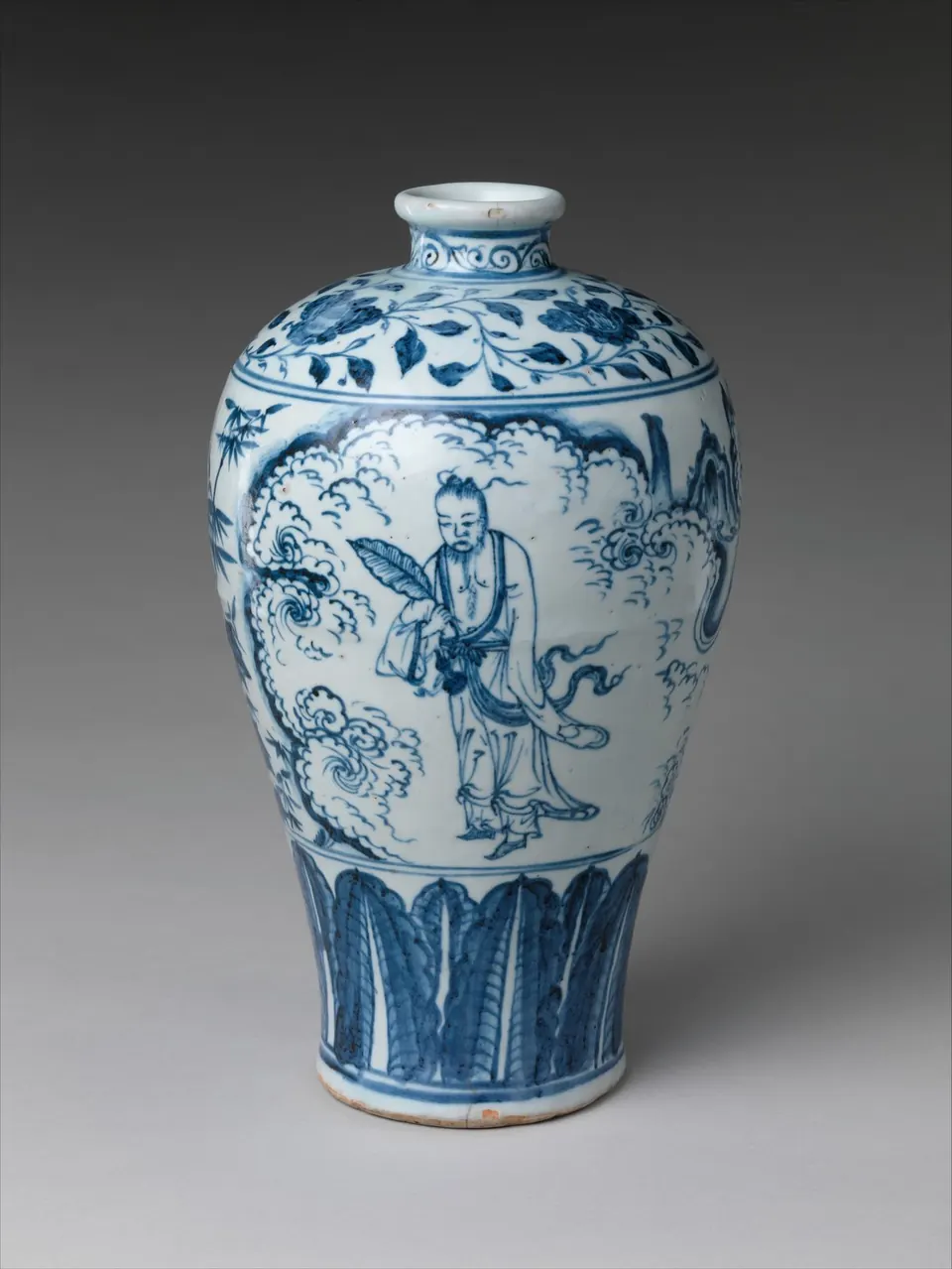
The Metropolitan Museum of Art · 2010.312 · CC0 public domain · museum page
Lesson
Ming Vase Art Lesson: Blue-and-White Design
Updated 2026-11-12
This Ming vase art lesson is for university, art-school and adult classes. Students look closely at museum objects, learn how underglaze cobalt and the imperial kilns shaped Ming blue-and-white, then design the decoration for a meiping or pear-shaped vase in the YinSeal studio and hang it in a class 3D gallery. It runs as one 75–90-minute class or a 3-hour studio, with an intro track and an advanced track.
| Learners | Undergraduates, art and design students, adult learners (18+) |
| Time | One 75–90-minute class, or one 3-hour studio that splits over two meetings |
| Tracks | Intro / Foundation and Studio / Advanced |
| Setting | In person, hybrid or online; one device per student, or one shared screen used in turns |
| Students make | A vessel design, a scene image, a written rationale and a critique contribution |
| You get | Lesson plan, 15-slide outline, two-page student brief, rubric, course-fit notes and a sourced fact file |
What students learn in this Ming vase art lesson
The lesson is built around three questions.
Material. Blue-and-white is cobalt painted on the body before glazing, covered with a clear glaze and fired at high temperature[1][2]. Once fired, every stroke is permanent, and a badly controlled kiln could turn the blue greyish black[3]. Students compare that one-shot discipline with a studio that has an undo button.
System. In the early Ming, imperial kilns were set up at Jingdezhen, and the central government "provided models and designs while also appointing superintendents"[4]. Students map how vessel form, horizontal bands and motifs work together, and learn which motif meanings museums actually document: purity for the lotus[5], wealth and honor for the peony[6], integrity and endurance for the Three Friends of winter[7], abundance for the fish[8], and "as one wishes" for the ruyi[9].
Circulation. The cobalt on a 14th-century jar in Cleveland "was imported from Iran, likely from Kashan"[10]. Blue-and-white was exported to Japan, Korea, Southeast Asia "and as far as Africa"[1], and Delft potters changed their style "in order to compete with Chinese porcelain"[11]. Students discuss where imitation ends and translation begins.
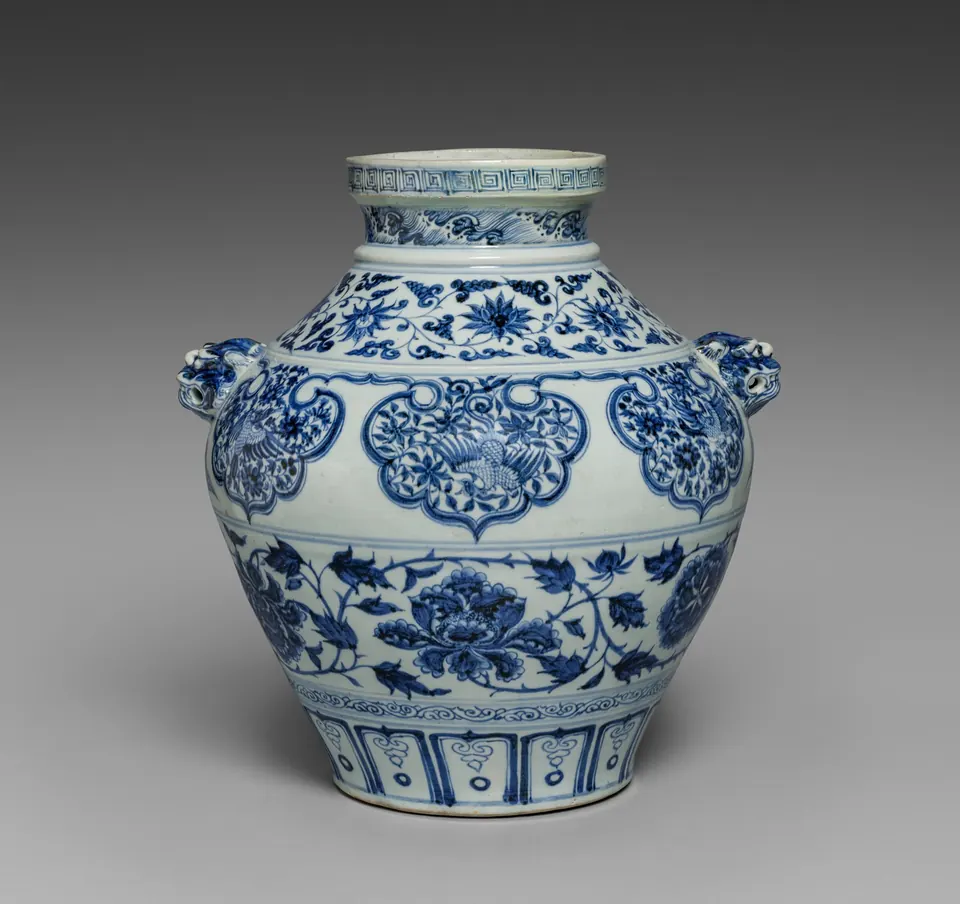
By the end, students can explain the underglaze process, analyze a vessel’s decorative structure in correct terms, place blue-and-white in 14th–18th-century trade, design a scheme that fits a specific form, and justify it in writing with reference to a museum object. Advanced students also argue a position on copying, translating or branding a visual tradition.
What students make in the studio
From the class link, with no account, each student:
- Picks a Meiping vase or Pear vase.
- Builds the structure first: shoulder band, main field, foot band. Bands only move up and down, so they always follow the vessel’s profile.
- Adds a main motif whose meaning is documented, and paints in three values of cobalt.
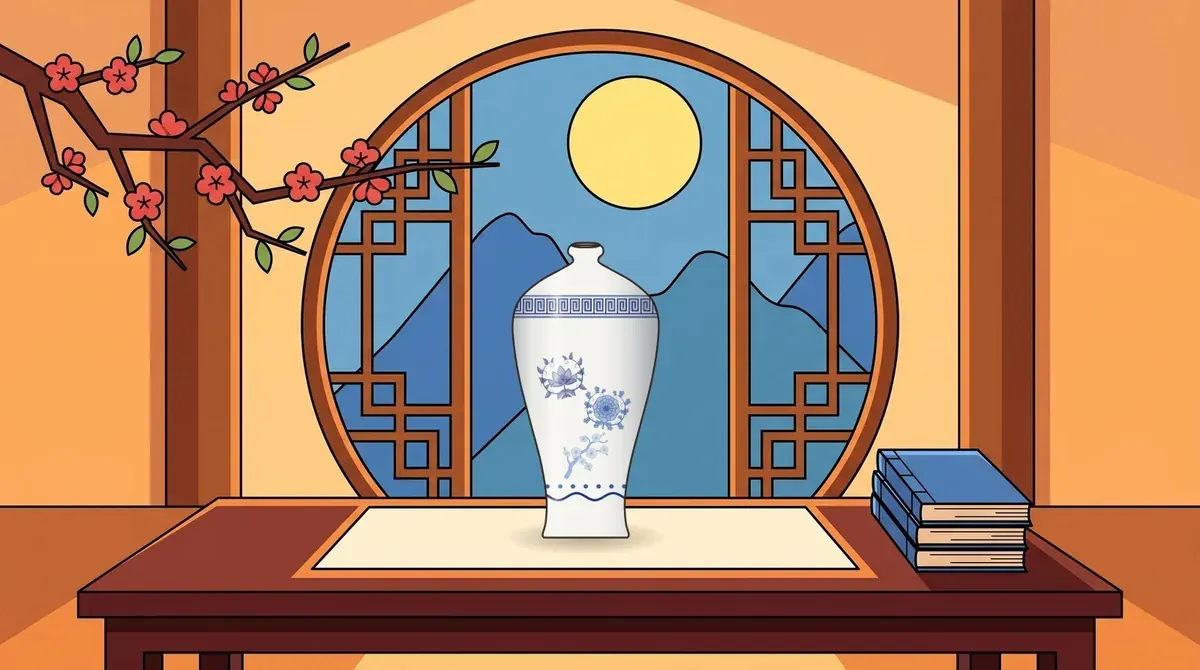
- Places the piece in a scene (moon-window desk, curio shelf, dinner table, sofa or museum plinth) and hands it in.
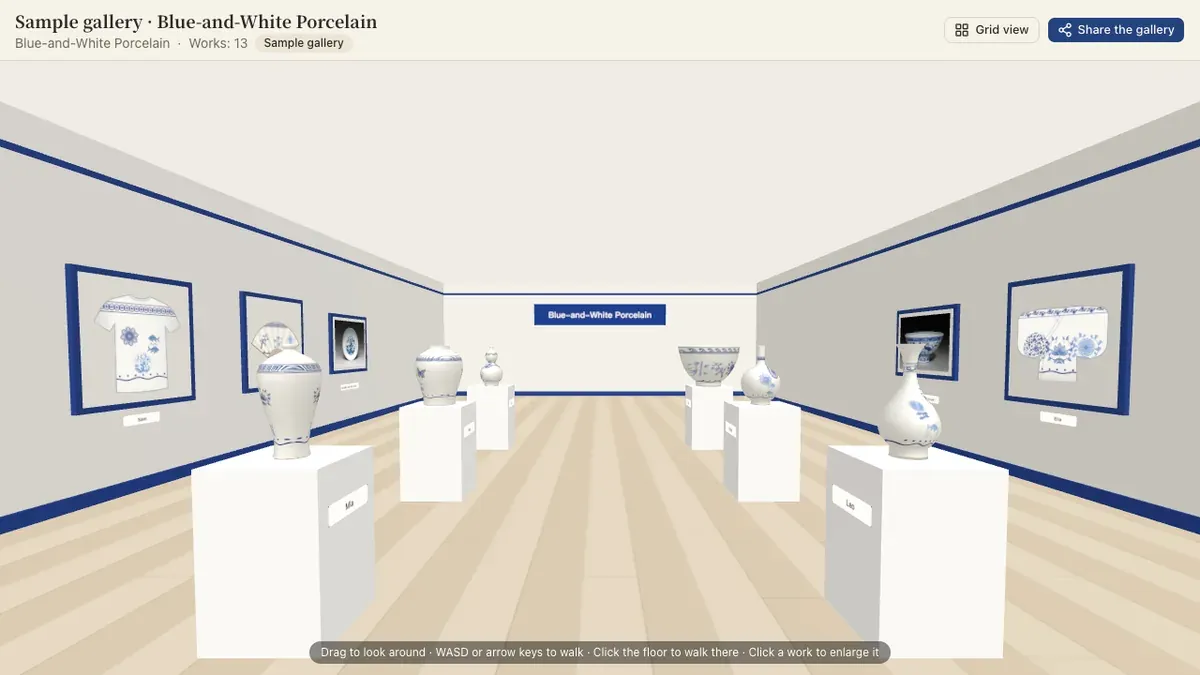
The class gallery becomes the room for critique. Painted vessels turn on plinths in 3D, and you can feature pieces for discussion or hide them.
On the advanced track, Brief B adds one constraint: transpose a museum object’s decoration to a different form, keep Ming band logic but replace the motifs with ones from your own visual culture, or design as a Delft workshop around 1690 competing with Chinese imports. Students revise after critique and hand in both versions.
Where the Ming vase art lesson fits
- Asian art history and Chinese art surveys: the Yuan–Ming transition, court arts, ceramics.
- Global design history and material culture: one design language followed from Jingdezhen to Iran, Iznik, Arita, Delft and Meissen.
- Ceramics: planning surface decoration before committing to clay. An extension applies the design to bisque with commercial underglaze.
- Surface and pattern design: main field against borders, fitting motifs to a curved profile, one hue in three values.
- Also: foundation 2D design, illustration, museum studies, Chinese language and culture courses, and adult evening or weekend workshops.
It is not designed to replace hands-on clay work, or to train students in dating or authenticating Chinese ceramics. For the motifs themselves, see blue-and-white porcelain patterns; for how bands repeat, frieze and wallpaper patterns.
What’s in the lesson pack
- Lesson plan. Timings for a 75–90-minute class and a 3-hour studio, step-by-step setup in YinSeal, nine discussion questions, a critique protocol with assigned roles, notes for intro, advanced, second-language and online classes, and a five-criterion rubric weighted separately for each track.
- Slide outline. 15 slides. Every suggested image is an open-access (CC0 or public-domain) museum object, labelled with museum and accession number and with its real dynasty.
- Student brief. Two pages: Brief A and Brief B, a vessel-anatomy planning table, thumbnails and a reflection page.
- Course-fit notes for nine kinds of course.
- Facts and sources. 41 entries, each with a verbatim quote and link, plus a list of popular claims we could not verify and kept out, such as a Ming-period meaning for the key-fret border.
Preview the lesson pack
Headings only. The full lesson plan, slides and student brief come with the lesson.
Step by step, with timings
- Before class: set up YinSeal (10 minutes)
- Slow looking (10–15 min)
- Context (15–30 min)
- Vessel anatomy exercise (10–20 min)
- Studio in YinSeal (30–60 min)
- Scene and hand in (5–10 min)
- Critique in the 3D gallery (20–30 min)
- Close and assign (5 min)
Lesson plan sections
At a glance · Overview · Tracks · Time and formats · Materials and setup · Learning outcomes · Key terms · Background for the instructor · Step by step · Discussion questions · Critique protocol · Differentiation · Assessment rubric · Extensions · Further reading · Cultural respect notes
Slides (15)
- Blue-and-White: A Design System in Cobalt and Clay
- Look before we label
- Where and when
- The material
- One shot: painting under glass
- Before the Ming: Iranian cobalt, Mongol taste
- Under the Ming
- The reign mark: "unified branding"?
- Anatomy of a vessel
- A vocabulary with documented meanings
- Export: Asia, Africa, Europe
- Imitation, competition, translation
- Same tradition, later dynasty
- Your brief
- Critique in the gallery
Price
There is no trial of the lesson pack; the sample pieces and sample gallery on this page show what students produce, and you can try the blue-and-white studio yourself in preview (with a watermark) before you buy. After payment you get the full lesson pack and can open a class straight away.
One lesson
$12
$4.80 if you buy in your first hour
- Lesson plan, slides and student brief for this lesson
- Run it with as many classes as you like, each with a 3D gallery
- Yours to keep, with no expiry
Annual pass
$59/year
$23.60 if you buy in your first hour
- Every lesson, including new ones as they come out
- Every work taken home without the watermark
- Unlimited photo 3D shows
Photo 3D show
$15
$6 if you buy in your first hour
- One 3D gallery of photographed paper work
- Up to 80 works
- The link stays live for 12 months
No trial of the lesson pack: the sample works and sample galleries are free to look at, and the studio itself can be tried in preview, with a watermark. See pricing
Ming vase art lesson: common questions
- Do students need accounts?
- No. Students open the class link and type a first name or nickname. Only the instructor signs in.
- Do I need ceramics experience to teach this Ming vase art lesson?
- No. The lesson plan includes background notes for the instructor, with a source for every historical claim. Ceramics instructors can add the underglaze extension.
- Does the lesson cover reign marks?
- Yes, as a question about branding and evidence: when marks became standard, and why later potters copied earlier ones. It does not teach authentication, and students design their own maker’s mark rather than copying a reign mark.
- Can I run it online?
- Yes. Share the student link in chat and screen-share the gallery for critique; pair feedback works in breakout rooms.
A Ming vase art lesson works when students face the decisions a Jingdezhen painter faced: which zone carries the idea, which motif, how much white to leave empty. This one gives them those decisions, the sources behind them, and a gallery to defend them in.
Sources
- V&A, Chinese blue-and-white ceramics (read 2026-11-11)
- Asian Art Museum (San Francisco), Lidded Jar with Design of a Lotus Pond (read 2026-11-11)
- V&A, Vase, C.66-1935 (Xuande period) (read 2026-11-11)
- National Palace Museum, Taipei, The Magic of Kneaded Clay: Ming Dynasty (read 2026-11-11)
- Cleveland Museum of Art, Prunus Vase (Meiping) with Blossoming Lotus, 1942.716 (read 2026-11-11)
- Cleveland Museum of Art, 1993.10 (read 2026-11-11)
- Cleveland Museum of Art, Bowl with Decoration of the "Three Friends", 1953.631 (read 2026-11-11)
- Cleveland Museum of Art, Fish, 1977.201 (read 2026-11-11)
- Cleveland Museum of Art, 1970.155 (read 2026-11-11)
- Cleveland Museum of Art, Jar with Lion-Head Handles, 1962.154 (read 2026-11-11)
- V&A, Bottle, C.2370-1910 (read 2026-11-11)
- Hillwood Estate, Museum & Gardens, 26.262 (read 2026-11-11)