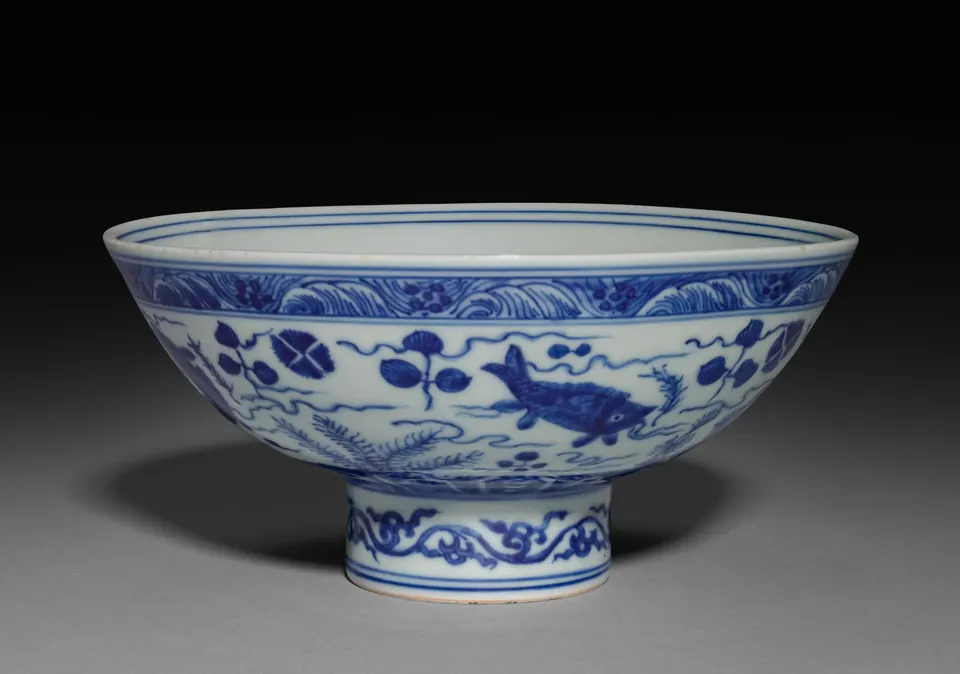
Cleveland Museum of Art · 1964.173 · CC0 public domain · museum page
Learn
Frieze Patterns and Wallpaper Patterns Explained
Updated 2026-11-12
Frieze patterns take one small motif and repeat it in a single direction, so the result is a band. Wallpaper patterns repeat the same motif across and down, so it covers a whole surface. In Chinese the pair is called 二方连续 (èrfāng liánxù, "continuous in two directions") and 四方连续 (sìfāng liánxù, "continuous in four"). One line to remember: two directions make a band, four directions cover a surface. The band of waves under the rim of the Ming bowl above is a frieze pattern[1]. This guide shows the difference on real objects, walks through the basic arrangements, and ends in the Pattern Lab, where you can draw your own.
Frieze patterns vs. wallpaper patterns
| Frieze pattern (二方连续) | Wallpaper pattern (四方连续) | |
|---|---|---|
| Repeats | in one line: left and right, or up and down | across and down |
| Result | a band | a filled surface |
| Typical place | rims, necks, shoulders and feet of pots; collars and hems | jar bodies, fabric, wallpaper, tiles |
| Real example | the wave band on a Jiajing bowl; rings of triangles on a Majiayao jar | floral scrolls covering a Yongzheng flask; rows of stamped squares on a Han tile |
| In mathematics | frieze groups: exactly 7 | wallpaper groups: exactly 17 |
The same motif can become either one. What changes is not the drawing but how many directions it repeats in.
How a unit repeats: three frieze pattern arrangements
The unit (单位纹样) is the piece that gets repeated. Below, the unit is a fish in the style of Neolithic painted pottery. It faces one way, so you can see at a glance when it has been flipped. The first cell of each row, outlined, is the original:
- Shift: every cell is the same, moved along. The simplest and steadiest band.
- Mirror: every other cell is flipped left to right, so the fish meet head to head and tail to tail. Calm and symmetrical.
- Alternate up/down: every other cell is flipped upside down, as if the motif walked along both sides of the band's centre line. More rhythm.
The labels p1, p1m1 and p11g are the mathematical names of these three arrangements. Counted by symmetry, frieze patterns come in only seven kinds[8]; the Pattern Lab starts with the three you will use most.
Four wallpaper pattern arrangements
With two directions to repeat in, a wallpaper pattern has more options:
- Grid: cells in straight rows and columns, like graph paper.
- Half offset: every other row slides half a cell, like brickwork. The same unit immediately looks less stiff.
- Mirror: flipped left to right and top to bottom, four cells to a group.
- Rotate: the four cells turn 0°, 90°, 180° and 270°, like a pinwheel.
Mathematicians count 17 wallpaper groups[9]. You do not need all of them: these four already cover most fabrics and wallpapers.
Frieze patterns on real pots and tiles

On blue-and-white porcelain, bands frame the main design rather than compete with it. The Freer Gallery describes a bowl from the first Ming reign as decorated with "peony, lotus and fungus scrolls, key bands and formal lotus leaf band"[2]. Key bands and lotus-leaf bands are textbook frieze patterns.
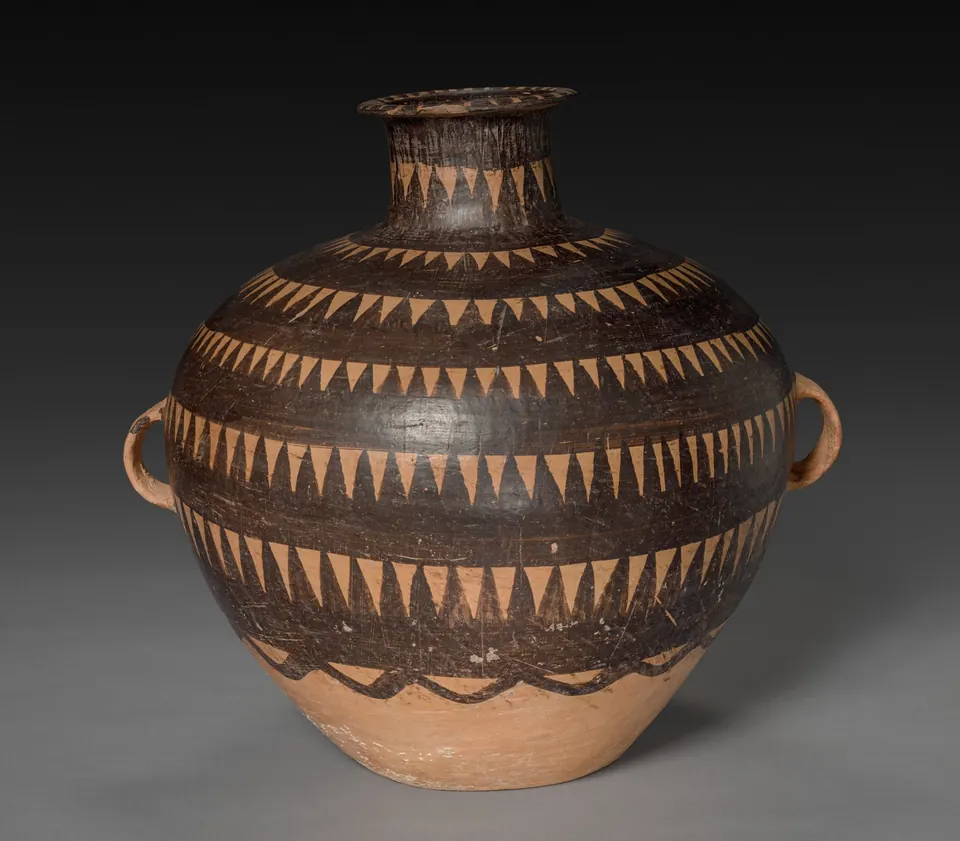
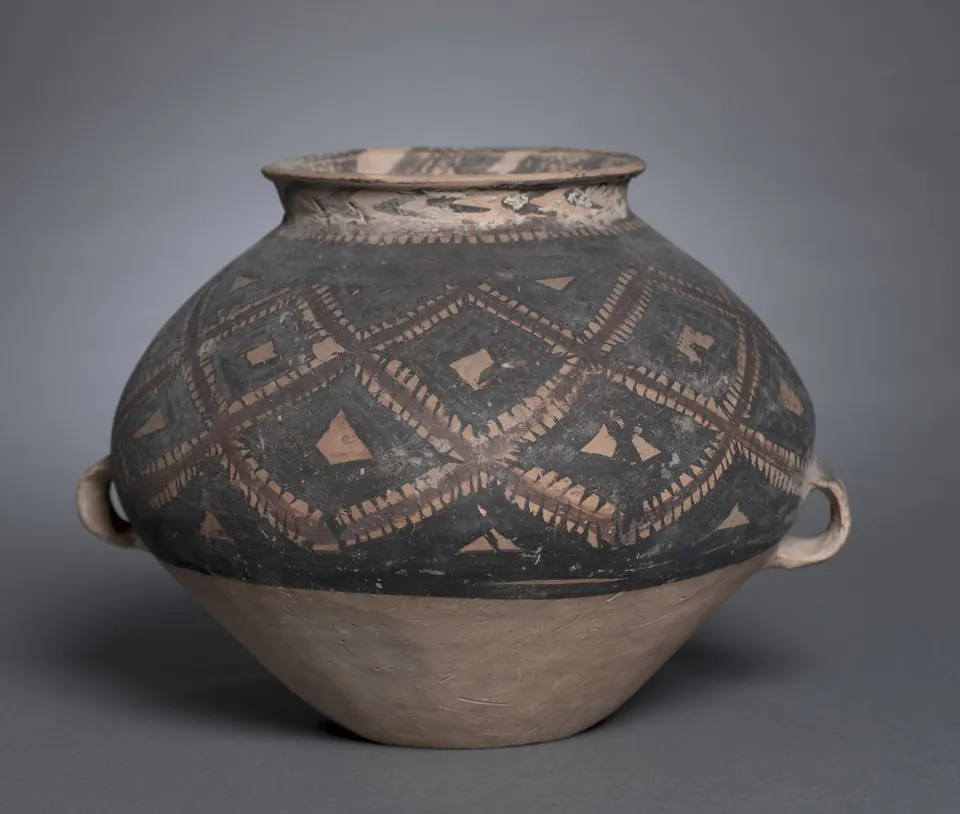
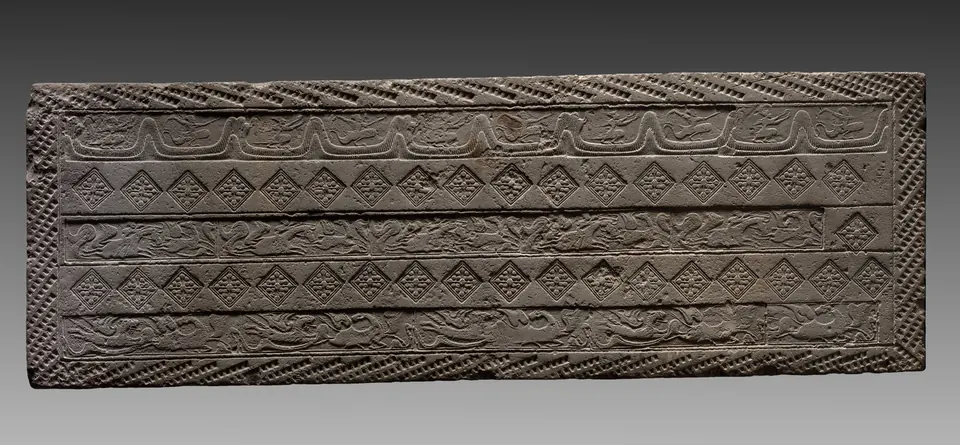
Painted pottery used them thousands of years earlier. Majiayao potters in northwest China were "renowned for production of vessels with black-slip painted patterns"[3], and the urn below is ringed with rows of triangles. A Neolithic vase from Gansu "is decorated with a continuous lozenge motif"[4]. Han tomb tiles carry stamped decoration[5]: look at the rows of identical motifs on the tile below and you are looking at the same idea.
Wallpaper patterns: covering the whole surface
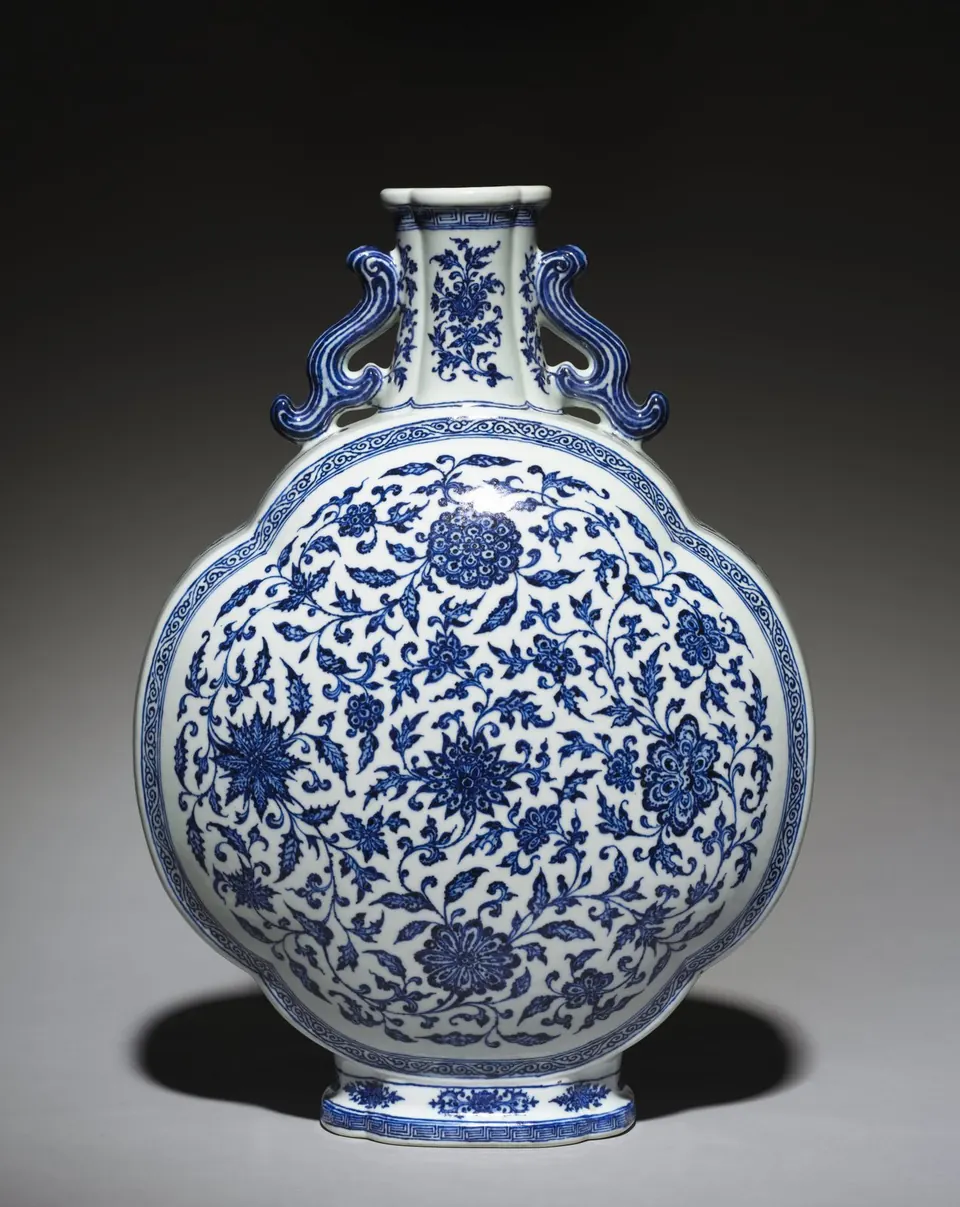
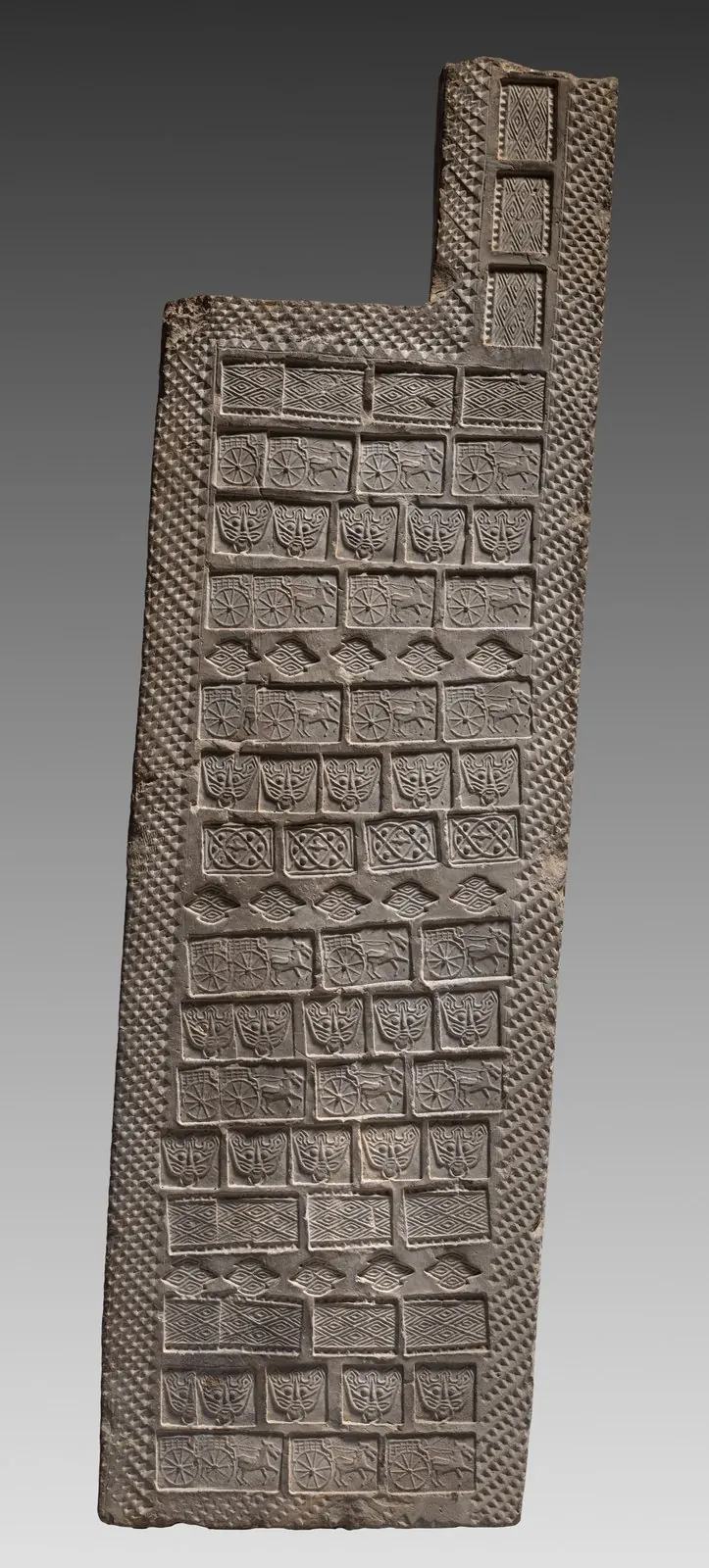
The museum describes this Yongzheng flask as "decorated with lotus and other flowers, leaves, and scrolling tendrils"[7]. It is not a strict cell-by-cell repeat, but the aim, covering the entire surface, is the aim of a wallpaper pattern. The Han tomb tile beside it is more literal: 117.5 × 35.3 cm of stamped squares in rows[6].
Draw a frieze pattern in the Pattern Lab
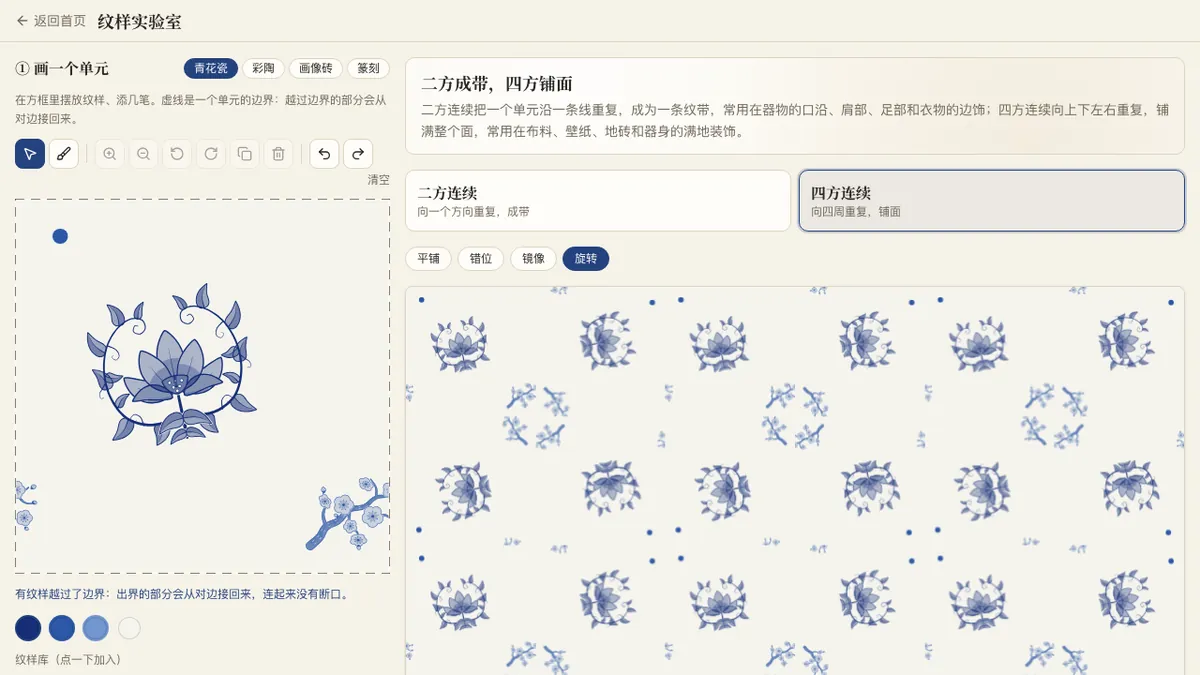
- Draw a unit. Add one or two motifs from the library, or a few brush strokes.
- Choose Band. Switch between Shift, Mirror and Alternate up/down and watch the band change.
- Turn on the seam check. Thin lines mark where cells meet; shapes crossing a line must continue on the other side.
- Switch to All-over. Try Half offset and Rotate; the same unit makes very different surfaces.
- Use it. Download a PNG, or put the band on a vase, a T-shirt or a tile, place it in a scene and hand it in to a class 3D gallery.
Four tips for better frieze and wallpaper patterns
- Keep the unit asymmetrical. A perfectly symmetrical motif looks the same shifted or mirrored, so the arrangements stop being different.
- Decide the band's height first. Rim and neck bands should be narrow; leave the big surface for the main design.
- Let motifs cross the edge. In a wallpaper pattern, what leaves on the right returns on the left and the seam disappears. The lab does the wrapping for you.
- Use few colours. Blue-and-white uses one cobalt in several strengths; painted pottery is mostly black and red. The limit is what makes it look right.
To see how bands frame a main design, read blue and white porcelain patterns. For whole surfaces stamped from moulds, read Han pictorial bricks.
What the Pattern Lab costs
Every studio can be tried first, with a watermark on the result; taking a work home without it is $4.90. To teach, buy a lesson ($12) or the annual pass ($59 a year: every lesson, and every work without the watermark). New accounts get 60% off in their first hour. See pricing
Images and copyright
The museum photographs come from the Cleveland Museum of Art's CC0 open-access images and may be used freely; each is credited with museum and accession number. The fish unit, the diagrams and the lab screenshots are YinSeal's own work.
Frieze patterns: common questions
- What is the difference between a frieze pattern and a wallpaper pattern?
- The direction of the repeat. A frieze pattern repeats a motif along one line, so it makes a band. A wallpaper pattern repeats it across and down, so it fills a surface. An easy way to remember it: two directions make a band, four directions cover a surface.
- How many kinds of frieze patterns are there?
- Classified by their symmetries, there are exactly 7 frieze groups and 17 wallpaper groups. In practice three frieze arrangements cover most borders: shift, mirror, and alternate up and down.
- How do I make a wallpaper pattern tile without visible seams?
- Whatever crosses the right edge of the unit has to come back in on the left, and whatever crosses the bottom comes back in at the top. The YinSeal Pattern Lab wraps these parts for you and has a seam check that draws the cell edges.
- Where do frieze patterns appear in everyday life?
- Bands around the rim, neck or foot of a pot, collars, cuffs and hems of clothes, and borders of all kinds are frieze patterns. Fabrics, wallpapers and floor tiles mostly carry wallpaper patterns.
- Should the repeating unit be symmetrical?
- No. An asymmetrical unit is better for learning: shifted, mirrored and alternated versions look clearly different, so you can see what each arrangement does.
Remember the rhyme, two directions make a band and four cover a surface, and you will spot frieze patterns and wallpaper patterns on every pot, plate and shirt you see. Next, draw a band of your own.
It opens with a sample unit you can change straight away.
Sources
- Cleveland Museum of Art, Bowl with Fish and Water Plants, 1964.173 (read 2026-11-12)
- Smithsonian National Museum of Asian Art (Freer), Bowl, F1951.3 (read 2026-11-11)
- Cleveland Museum of Art, Urn with Triangular Patterns, 2017.21 (read 2026-11-12)
- Cleveland Museum of Art, Vase, 1930.333 (read 2026-11-12)
- Cleveland Museum of Art, Tomb Tile, 1915.70 (read 2026-11-12)
- Cleveland Museum of Art, Tomb Tile, 1915.73 (read 2026-11-12)
- Cleveland Museum of Art, Gourd Flask with Floral Scrolls, 1964.226 (read 2026-11-12)
- Wikipedia, Frieze group (read 2026-11-12)
- Wikipedia, Wallpaper group (read 2026-11-12)