Learn
Chinese Seal Logo: Your Shop’s Name in Seal Script
Updated 2026-11-13
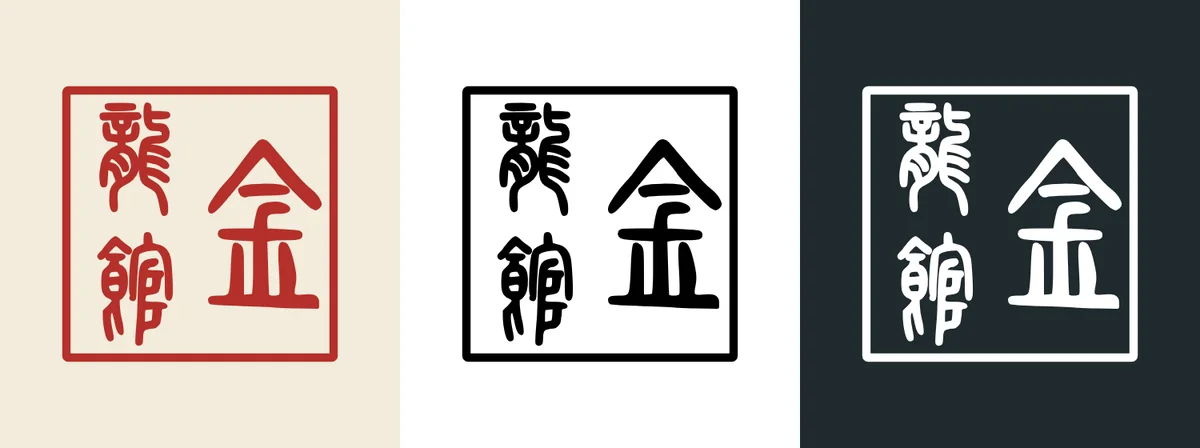
A Chinese seal logo is your shop’s name carved in seal script and printed in red, like the seals that show who made or owned a Chinese painting[1]. Small seal script, with its lines of even thickness and many curves, was standardised when China was first unified in the third century BCE, and seal carvers still use it[2]. For a tea room, a restaurant, a martial-arts school or a clinic, a seal logo says where your craft comes from. This page covers choosing the characters, the files you get, and what the licence does and doesn’t cover.
Choose the characters
A seal holds one to four characters. Type your shop’s Chinese name if it has one. If not, build it from characters shops often use, each listed with its pinyin and a plain English meaning:
- Endings for a shop name: 馆 (house, hall), 堂 (hall), 居 (dwelling), 斋 (studio), 阁 (pavilion), 记 (a shop’s mark: 陈记, Chen’s).
- What you do: 食 (food), 饭 (meal), 酒 (wine), 武 (martial), 拳 (boxing), 道 (the Way), 医 (medicine), 药 (herbs).
- Good wishes and nature: 福 (good fortune), 金 (gold), 龙 (dragon), 云 (cloud), 山 (mountain), 竹 (bamboo).
Or spell a name by sound, such as the owner’s. Whatever you choose, ask someone who reads Chinese to check the whole name before it goes on a sign.
Why shop seals use a different font
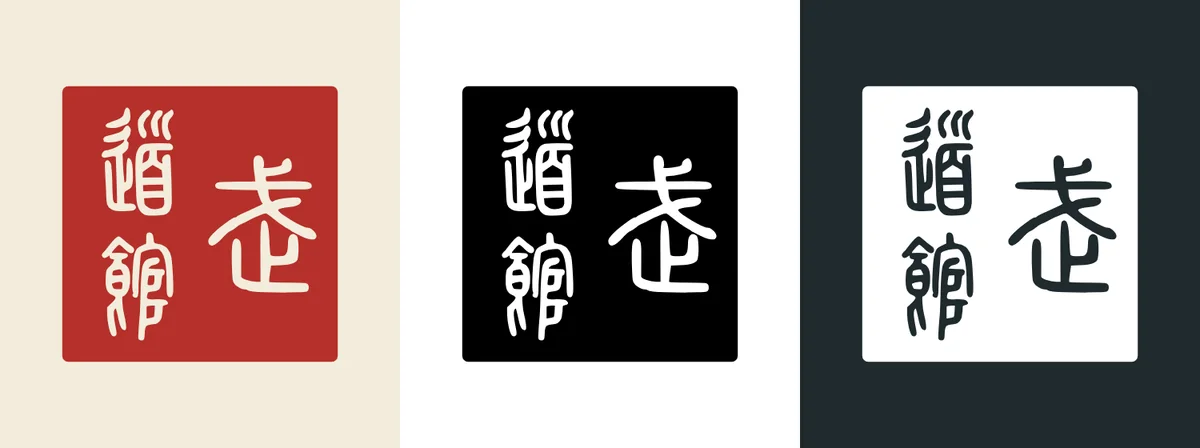
Name seals in YinSeal are drawn with Chongxi Seal Script, licensed CC BY-ND 3.0 TW: it requires attribution and does not allow the glyphs to be changed[5]. A logo should not have to carry a font credit, so shop seals use Chine-Culture Xiaozhuan instead, a free font under the SIL Open Font License. Its glyphs come from the Ancient Chinese Characters project on Wikimedia Commons, released into the public domain, and it has 3,883 drawn characters[4].
The OFL’s own FAQ says you may use an OFL font for a logo with no further permission, that you remain the author of the logo, and that crediting the font is welcome but not required[3]. The cost is coverage: some common modern characters, such as 茶 (tea), 和 and 美, have no form in it. The studio names any character it cannot carve as you type.
The files you take away
- Logos: vector SVG and transparent PNG (2048 px) in red, black, and white for dark backgrounds, cropped to the seal. Give the SVG to sign makers and printers.
- A stamped look: the red logo with the worn edges of a real impression.
- Stamp artwork: mirrored, black on white, at 20, 30, 40 and 50 mm (SVG in millimetres, PNG at 300 dpi), for a rubber or wooden stamp to mark bags, cups and menus. Ask the stamp maker whether they want mirrored or right-reading art.
- The licence, as a text file in English and Chinese.
What the licence covers
- Yes: use the seal as your logo or brand mark anywhere, recolour it, resize it, set it beside your own lettering. No credit needed.
- Not exclusive: anyone can carve the same characters in the same style, with YinSeal or with the same free font.
- Not a trademark clearance: we don’t check whether the design can be registered. Search the register where you trade, such as the USPTO’s trademark database in the United States[6], and ask a trademark lawyer before you file.
- It follows the work: the licence stays with the files you take away, and ends if the order that unlocked them is refunded.
Price
Every studio can be tried first, with a watermark on the result; taking a work home without it is $4.90. To teach, buy a lesson ($12) or the annual pass ($59 a year: every lesson, and every work without the watermark). New accounts get 60% off in their first hour. See pricing
Chinese seal logos: common questions
- Can I use the seal as my business logo?
- Yes. A shop seal you take away comes with a commercial licence: signs, menus, packaging, uniforms, websites and products you sell. No credit to us or to the font is needed.
- Can I register it as a trademark?
- We don’t check, and can’t promise, that it can be registered. The licence is not exclusive: anyone can carve the same characters in the same style. Search the trademark register where you trade and talk to a trademark lawyer before you file.
- Why can’t I carve 茶 (tea)?
- Shop seals use a free font under the SIL Open Font License so that a logo needs no font credit. It has about 3,900 characters drawn from ancient sources, and some common modern characters, 茶 among them, are not in it. The studio tells you at once which characters it cannot carve.
- What files do I get?
- Vector SVG and transparent PNG logos in red, black and white, a red version with the worn look of a real stamp, mirrored stamp artwork at 20, 30, 40 and 50 mm for a rubber or wooden stamp, and the licence as a text file.
- I don’t read Chinese. How do I choose characters?
- Pick from a list of characters shops often use, each with its pinyin and a plain English meaning, or spell a name by sound. Then ask someone who reads Chinese to check the whole name before it goes on a sign.
Type your shop’s Chinese name or pick characters, choose red or white text, and take the logo files with a commercial licence.
Sources
- University of Washington, A Visual Sourcebook of Chinese Civilization (Patricia Buckley Ebrey): Technical Aspects of Painting (read 2026-11-13)
- Encyclopaedia Britannica, Chinese calligraphy (Internet Archive copy) (read 2026-11-11)
- SIL Open Font License, OFL-FAQ (questions 1.1, 1.1.2 and 1.13) (read 2026-11-13)
- Chine-Culture Xiaozhuan, README (version 1.000), as shipped with the font (read 2026-11-13)
- Academia Sinica, Chongxi Seal Script (崇羲篆體) licence (read 2026-11-11)
- USPTO, Search our trademark database (read 2026-11-13)