Learn
Chinese Wedding: Double Happiness Signs and Seals
Updated 2026-11-13
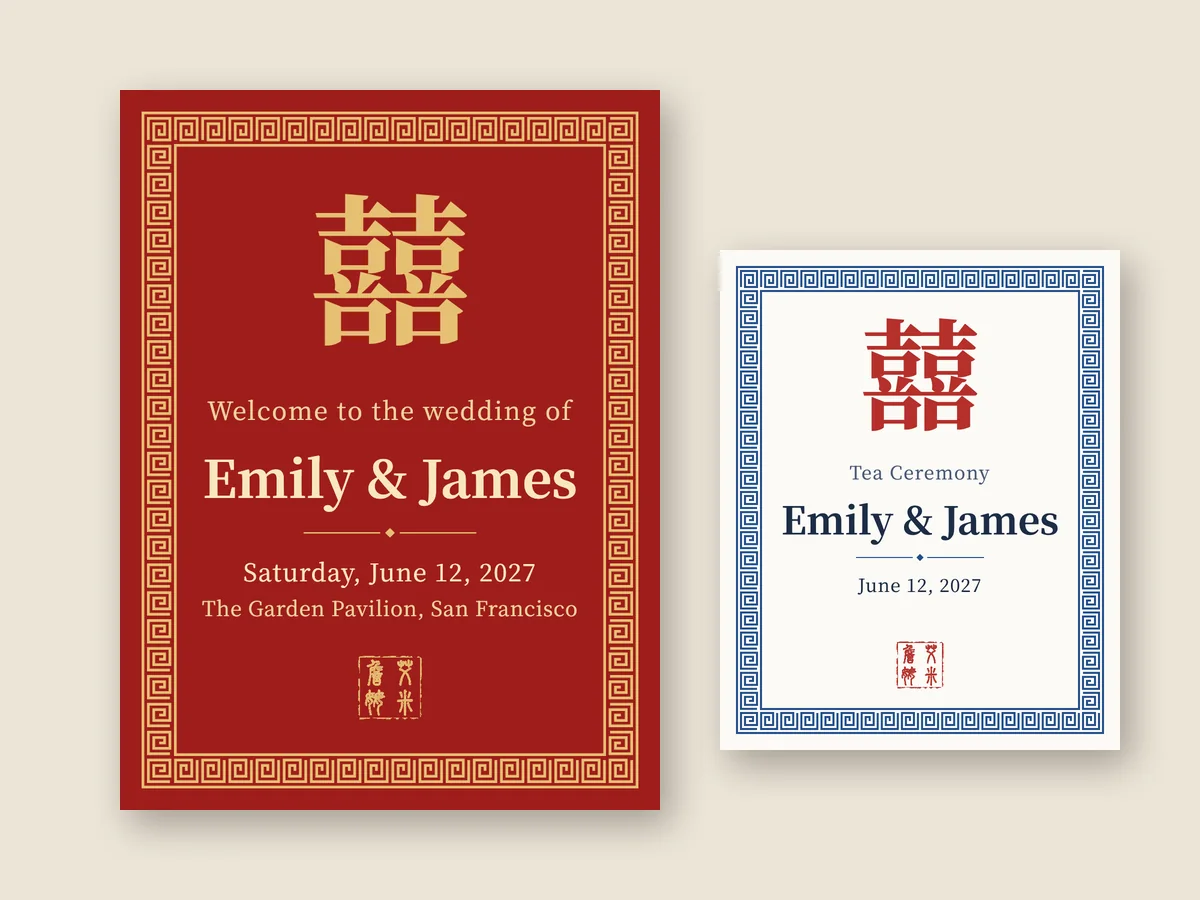
A Chinese wedding has a few things guests notice first: the red double happiness character 囍 on the doors and the decorations, a sign at the entrance, a tea ceremony for the families, and red envelopes. This page explains what 囍 means and then shows how to make your own set online: both your names carved into one seal, welcome and tea ceremony signs stamped with it, red envelopes ready to print, and a 囍 paper cut.
What double happiness 囍 means
囍 is the character 喜 (xǐ, joy) written twice and joined into one, read shuāngxǐ, "double happiness". Putting up 囍 for a newly married couple is a wedding custom. A story told in many books says the poet and statesman Wang Anshi wrote the first one, on the day he passed the imperial examination and married; the essay we draw on calls that story something to take with a pinch of salt[1].
Characters joined like this are an old habit. People call them lucky characters, and folklorists call them auspicious compound characters (吉祥合體字); shop doors still carry 招財進寶, "bring in wealth and treasure", written as one character. No record or object yet shows when 囍 itself first appeared, but four-character compounds on Qing dynasty charm coins already look like the ones shops use today, so some of these compounds had settled by the Qing at the latest[1].
Your names in one seal
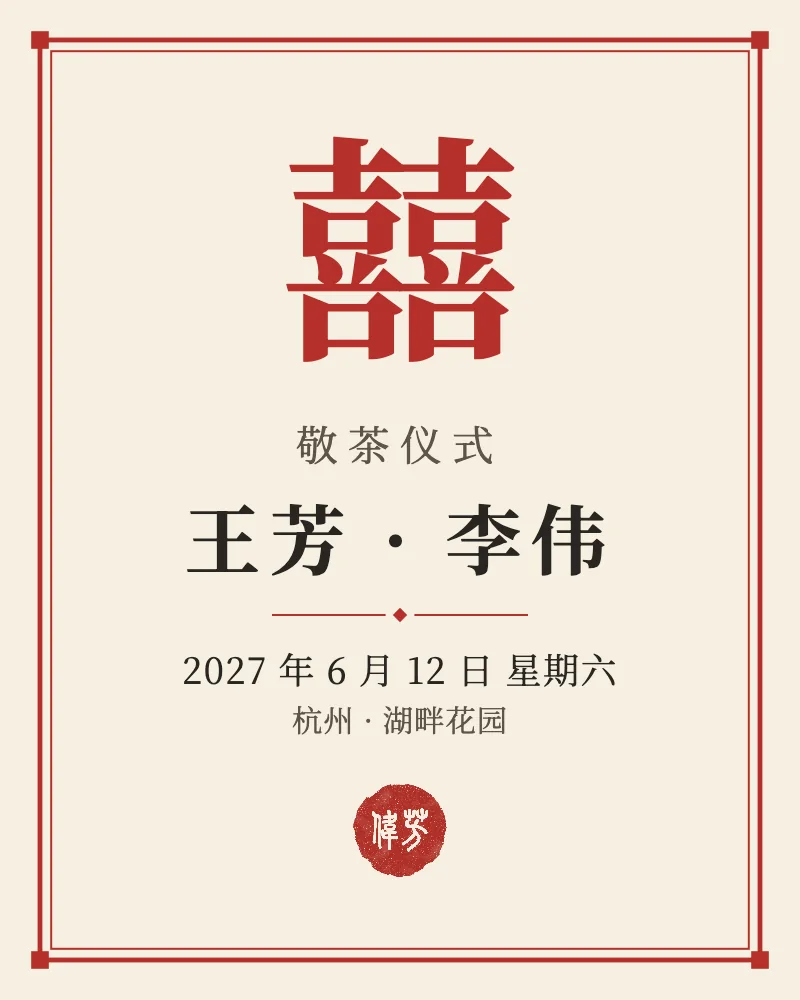
A seal (印章) carries a name in seal script, and a couple can share one. Type both English names and pick a Chinese rendering for each (every character comes with its pinyin and meaning), or type Chinese names directly. When each name has one or two characters, both go into one seal: the first name fills the right column, which is read first, and the second name the left. Longer names become a matching pair of seals, and you choose red characters (朱文) or white characters (白文) for each.
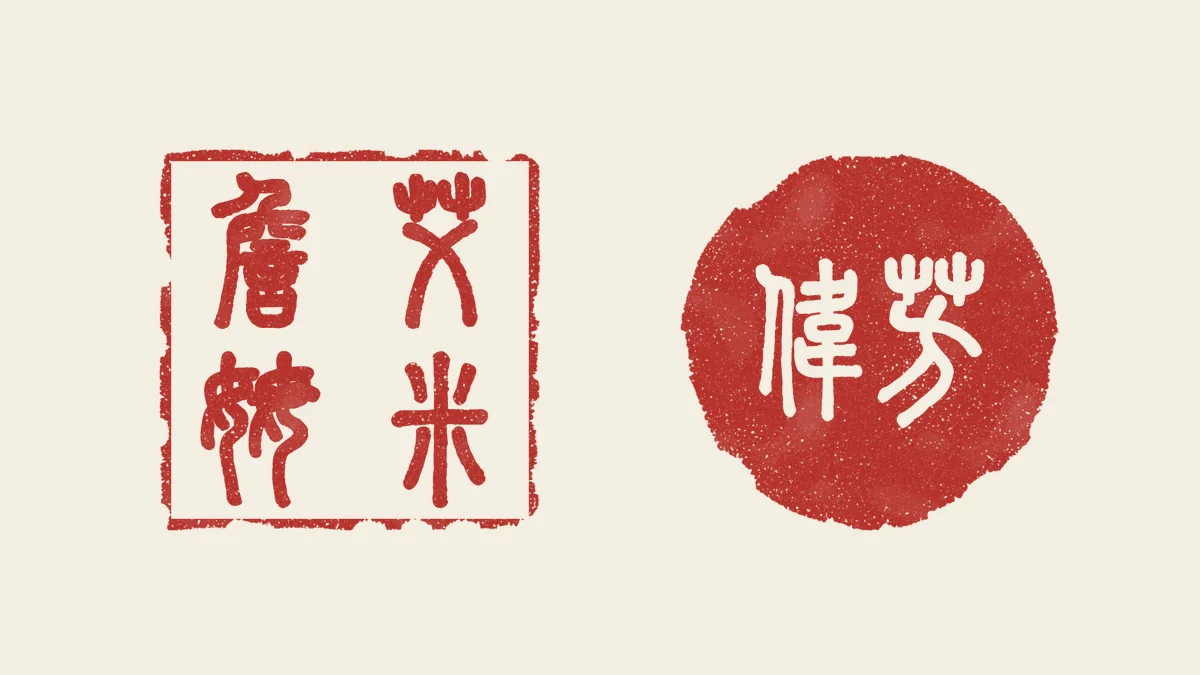
The seal download has the seal as PNG and SVG, mirrored files at 10–25 mm for a seal carver or a laser engraver, and a stencil. The same seal can then be stamped on your signs and envelopes.
Welcome and tea ceremony signs
A tea ceremony is when tea is served to the parents and elders; traditionally the bride serves her own parents at home on the wedding morning, before the groom arrives[3]. A small sign on the tea table tells guests what is happening and whose families are meeting.
The wedding studio has four sign designs: crimson and gold with a 回纹 border, rice paper with a red frame, blue and white, and gold leaf. Each has the 囍 character, your heading, names, date and place, and your seal if you have carved one. Welcome signs come at 18 × 24 in, 24 × 36 in or A2; tea ceremony signs at 8 × 10 in or 11 × 14 in. Every download also has A4 and US Letter PDFs to print at home.
Red envelopes
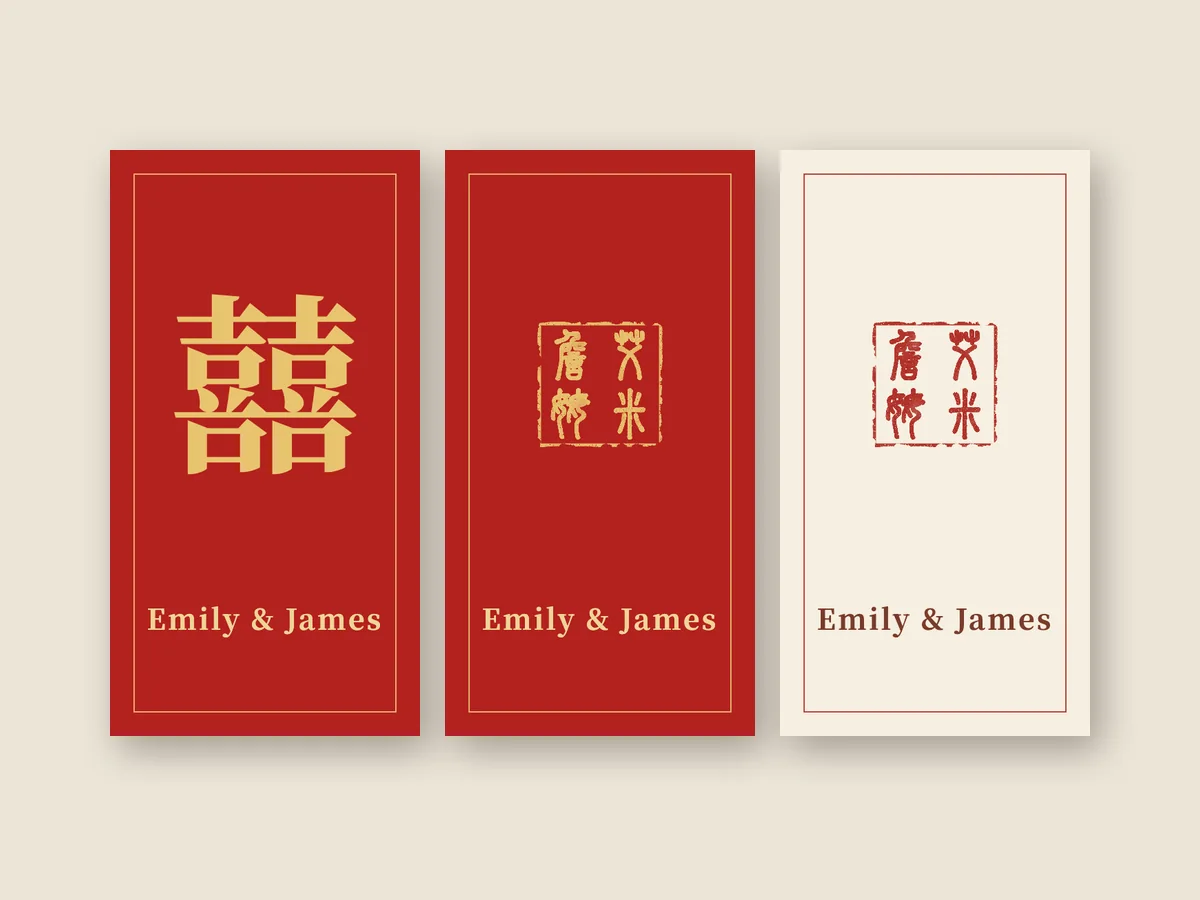
Red envelopes carry money gifts; the British Museum catalogues one as a lucky red envelope, hóngbāo in Mandarin and lai see in Cantonese[2]. The wedding studio makes the print file for your own: a 90 × 170 mm envelope with 囍 or your seal and your names on the front.
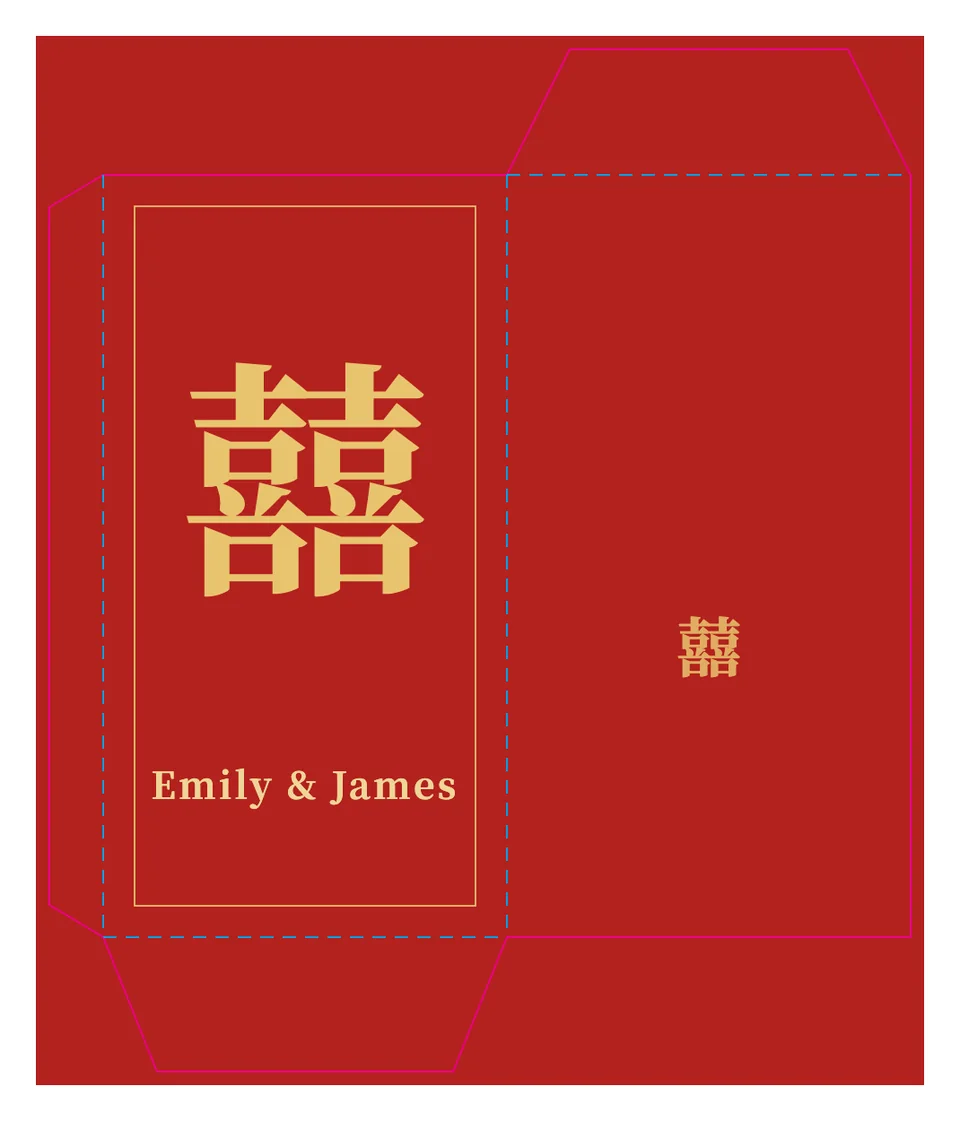
The download has the flat sheet with cut and fold lines as an SVG in millimetres, the artwork with 3 mm of bleed (colour running past the cut line so no white edge shows), the front alone for a printer with their own die line, and step-by-step folding. The flat sheet fits on A4 and US Letter, so you can print and fold them at home.
A double happiness paper cut
The paper cutting studio has ready-made 囍 designs, cut from red paper folded in half: one 喜 cut against the fold opens into two. Start from one or cut your own; the SVG and DXF files work with Cricut machines and laser cutters.
Carve your couple’s seal, then make the signs and red envelopes with it.
Anyone can design in the studio. What you make shows a watermark until you take it away with a download or a pass; each sign, each envelope and the seal counts as one work, and a second size of the same sign is free.
Chinese wedding: common questions
- What does the double happiness character 囍 mean?
- It is the character 喜 (xǐ, joy) written twice and joined into one, read shuāngxǐ, "double happiness". Couples put it up at weddings. Folklorists call joined characters like it auspicious compound characters.
- Can both of our names go in one seal?
- Yes, when each name has one or two Chinese characters: the first name fills the right column, which is read first, and the second name the left. With longer names the studio makes a matching pair of seals, one for each of you.
- What sizes are the welcome signs?
- You choose 18 × 24 in, 24 × 36 in or A2 for the welcome sign, and 8 × 10 in or 11 × 14 in for the tea ceremony sign. Every sign also comes as A4 and US Letter PDFs to print at home.
- Can I print the red envelopes myself?
- Yes. The envelope is 90 × 170 mm when folded, and the flat sheet with its bleed fits on A4 or US Letter. Print at 100%, cut along the solid line, fold on the dashed lines and glue the two flaps. A print shop can use the same file, or the front alone if it has its own die line.
- Which fonts are in the files?
- The lettering on the signs and envelopes is Noto Serif SC, under the SIL Open Font License. The seal characters come from Chongxi Seal Script by Academia Sinica (CC BY-ND 3.0 TW). The README in every download gives the credit lines.
Sources
- Hong Kong Education Bureau, 「囍」 (Double happiness), reading by Wanyan Shaoyuan (完顏紹元), Chinese learning materials for non-Chinese speaking students, 2021 (read 2026-11-13)
- British Museum, money envelope (lucky red envelope), 2005,0220.15 (read 2026-11-13)
- Chinese Historical and Cultural Project, Chinese Wedding Tea Ceremony (read 2026-11-13)