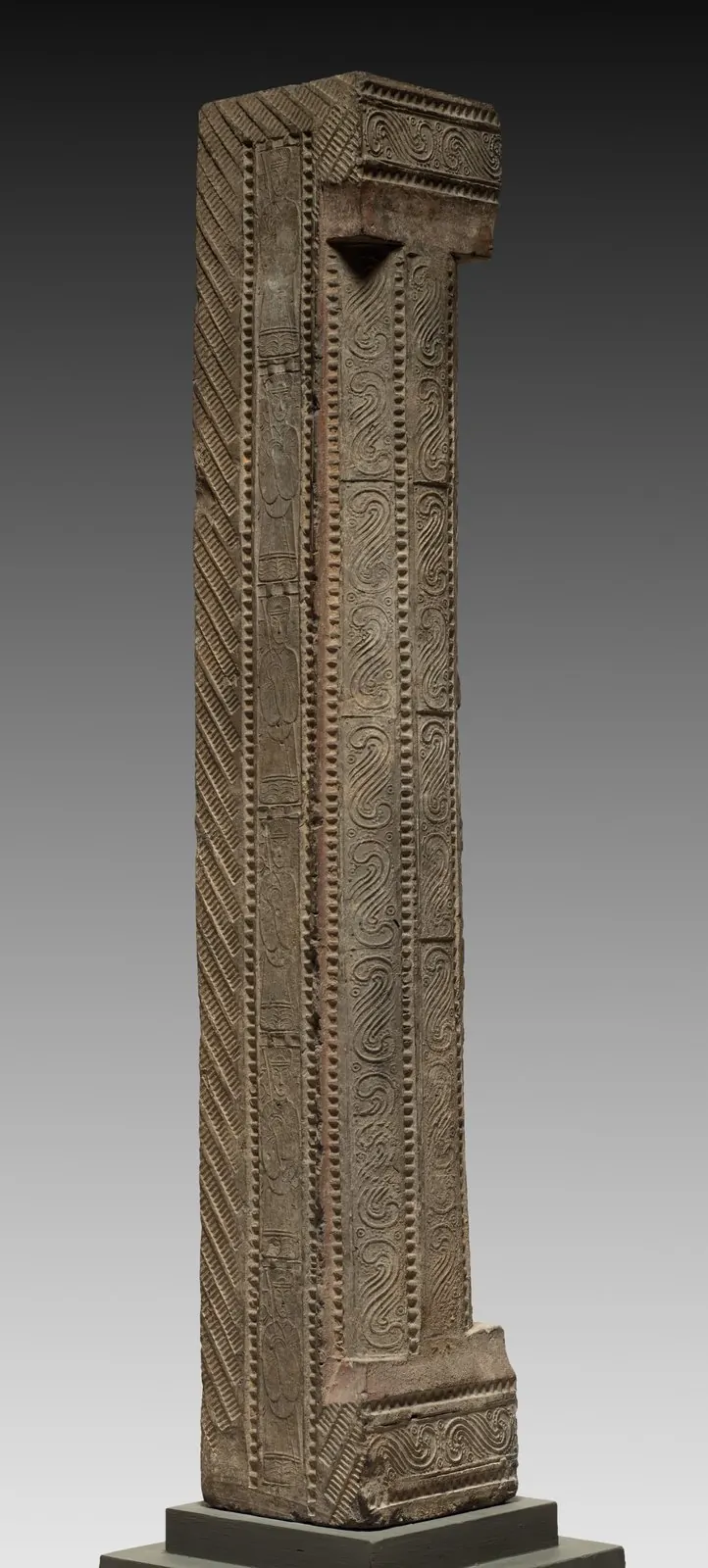
Cleveland Museum of Art · 1915.68 · CC0 public domain · museum page
Learn
Han Pictorial Bricks - Scenes and Rubbings
Updated 2026-11-12
Han pictorial bricks (画像砖, huàxiàng zhuān) are bricks with pictures pressed or carved into their faces, built into tombs during the Han dynasty: chariot processions, guardian animals, hunters and harvesters. The Cleveland Museum of Art explains that by the first century AD, tombs lined with decorated bricks and tiles had replaced earlier tombs built only with rammed-earth walls[1]. Using open-access museum images, this guide shows what Han pictorial bricks depict, how they differ from carved stone, and how rubbings are taken. Then you can compose a brick of your own and take its rubbing.
What Han pictorial bricks are: a house underground
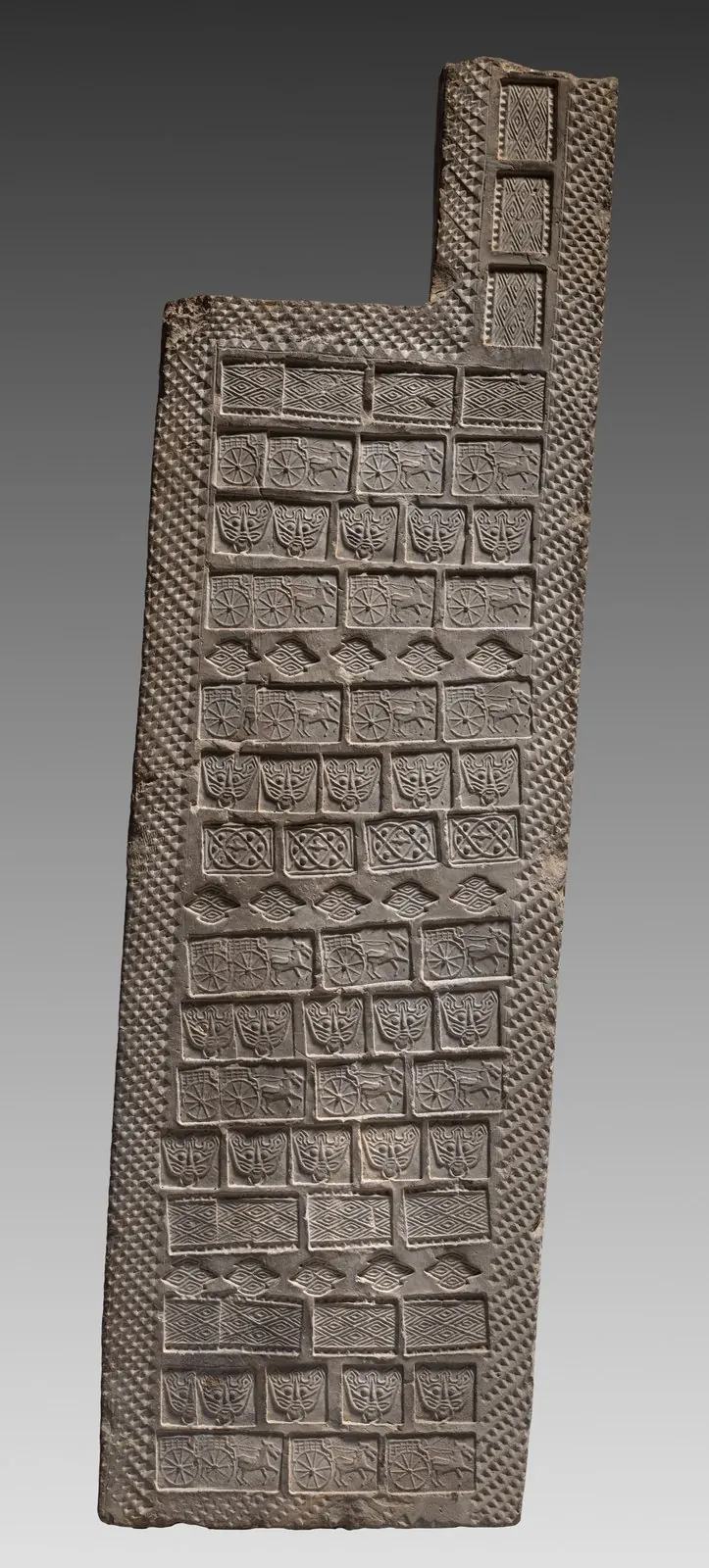
The column at the top of this page is a hollow tile from the doorway of a Han tomb chamber, 113.7 cm tall[1]. The museum’s description is precise:
- Stamped images: striding tigers at the top, racing horsemen down the right and reverent officials down the left, all stamped into the surface.
- Built like timber: the doorway preserves the post-and-lintel structure of Chinese wooden architecture.
- Life carried below ground: these more durable chambers were filled with ceramic models of stoves, houses, servants and pets, "symbolically extending the creature comforts of this world into the world after death".
Model stoves were made the same way: four earthenware panels pressed in moulds and joined into a miniature stove[3]. A tomb tile more than a metre long (117.5 × 35.3 cm) also carries stamped decoration[2].
Why put pictures in a tomb?
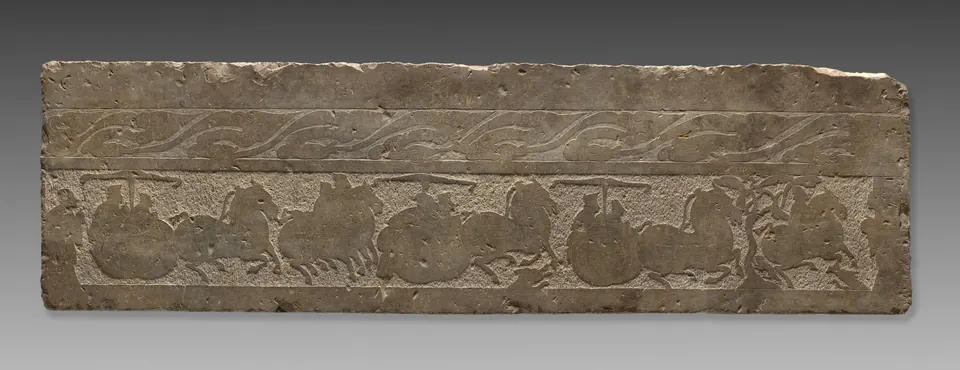
Han dynasty tombs "were often furnished with grave goods to provide the deceased with items for the afterlife"[3]. The images belonged to the same idea: processions, guardians and scenes of plenty surrounded the dead. Cleveland’s chariot frieze, the museum suggests, may originally have been carved for a local Eastern Han family tomb of similar status to the Wu family’s[6].
When you look at Han pictorial bricks, read them in order: the border first (clouds, lozenges, coins), then the main band, then look for repeats. On stamped tiles the same motif often appears again and again, most likely because one mould was pressed again and again.
Pictorial bricks vs. pictorial stones
| Pictorial brick (画像砖) | Pictorial stone (画像石) | |
|---|---|---|
| Material | fired clay | stone |
| How the image is made | on this page, stamped with moulds | carved in low relief with engraved detail |
| Examples here | Cleveland’s hollow-tile column and tomb tiles | Cleveland’s Eastern Han chariot frieze; the Met’s limestone tomb panel |
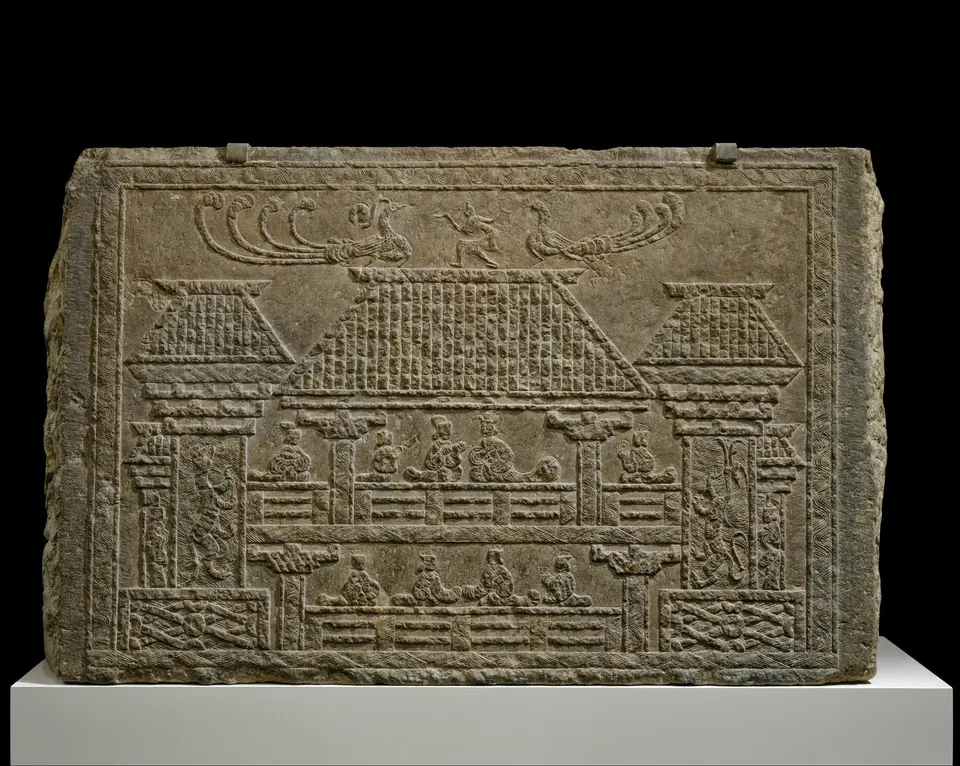
Cleveland’s chariot frieze is in the style of the Wu Family Shrines at Jiaxiang, Shandong[6]; the Met’s panel is an early second-century Eastern Han limestone relief, 127 cm wide[7]. The subjects overlap; the technique differs. Bricks are pressed, stones are carved.
What Han pictorial bricks show
- Chariot processions: horse-drawn chariots pass through country full of wild animals, with a monkey climbing a tree; a border of swirling clouds above suggests heaven or the land of immortals[6].
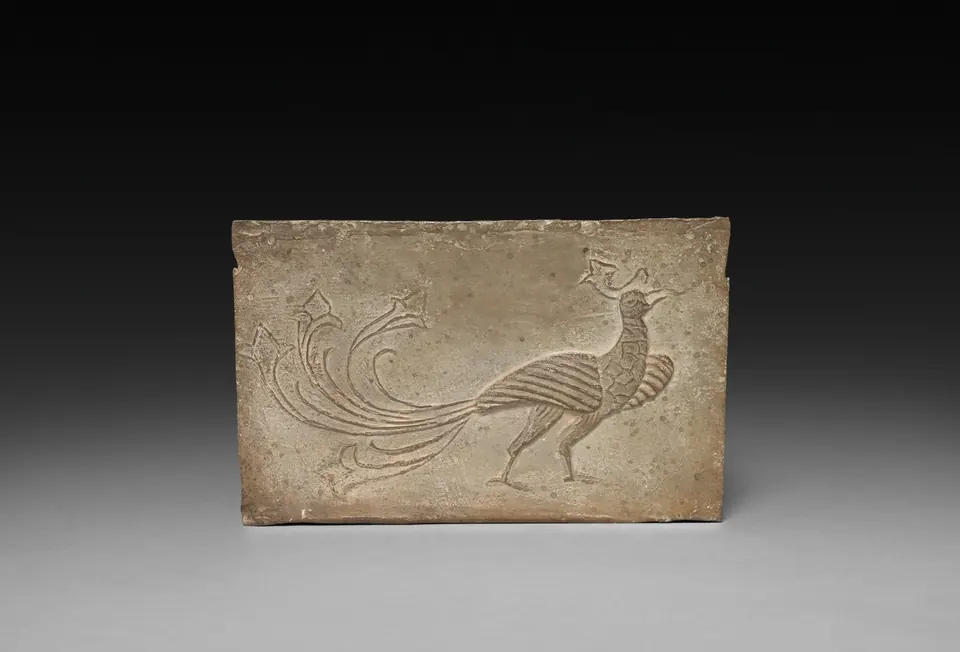
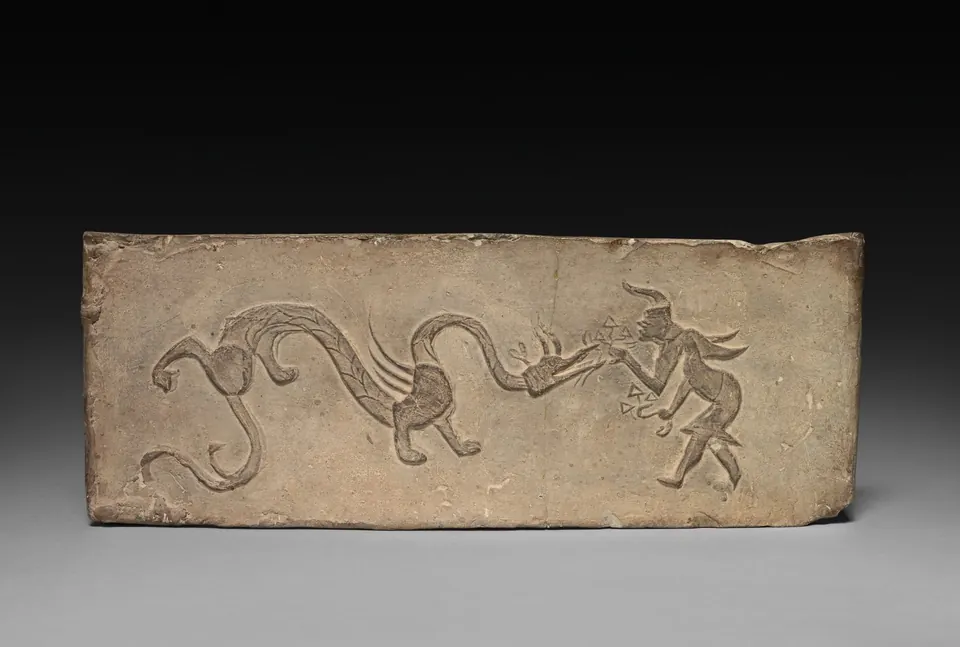
- Guardian animals: the four sides of a Han model stove show the animals of the cardinal directions, the dragon of the east facing the tiger of the west, and the vermilion bird facing south[4]. The dragon is "an auspicious creature" that protects the east[5].
- Hunting and harvest: an Eastern Han brick in the Sichuan Museum, unearthed in 1972 in Dayi county, Chengdu, shows archery and hunting by a lotus pond above and rice harvesting below: two men swing sickles, three bend to pick grain, another shoulders sheaves and carries a food box[9].
YinSeal has redrawn a set of motifs in the Han style that you can combine freely. Where a card names an origin or a meaning, it links the source:
- Archer shooting geese弋射Drawn from:Modelled on an Eastern Han brick in the Sichuan Museum whose upper scene shows archery and hunting by a lotus pond. Source
- Harvest收获Drawn from:Modelled on the lower scene of the same brick: rice harvesting with sickles. Source
- Azure Dragon青龙Meaning:The dragon is an auspicious creature and the animal of the cardinal directions that protects the east. Source
- Vermilion Bird朱雀Meaning:The stove’s four sides show the animals of the cardinal directions; the vermilion bird faces south. Source
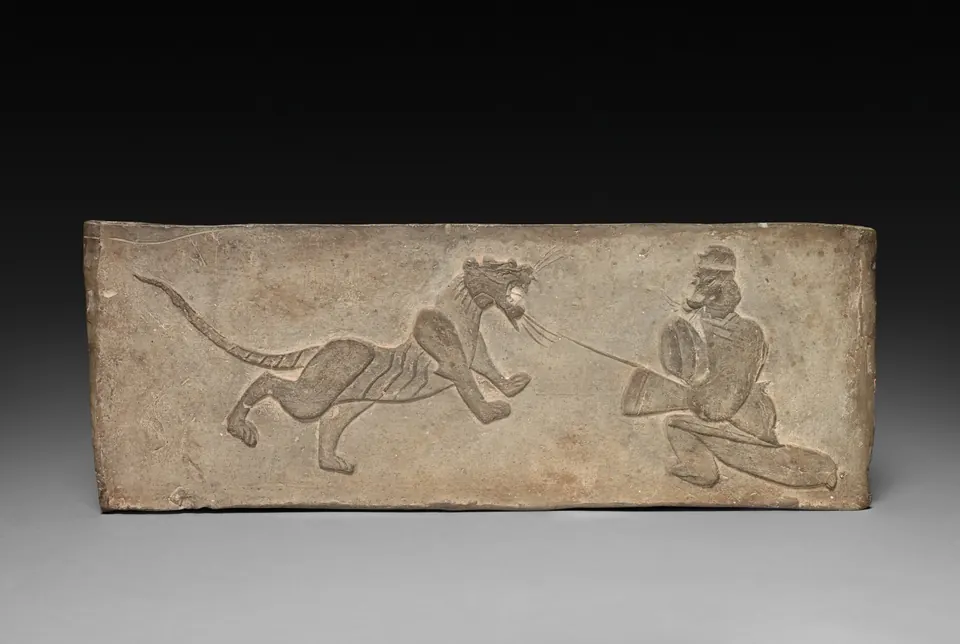
- Tiger (from an original rubbing)老虎(原物拓样)Drawn from:From a Western Han stove panel: the western tiger, fended off by a lancer. Source
- Galloping horse奔马
- Horse and carriage车马(轺车)
- Cloud scrolls卷云纹Meaning:Above a Han chariot procession, the museum says, the swirling clouds suggest heaven or the land of immortals. Source
How a rubbing of a Han pictorial brick is made
A rubbing turns a carved or stamped surface into a flat black-and-white picture. Cleveland describes the method alongside its chariot frieze[6]:
- Lay a moistened sheet of paper over the slab.
- Tamp it with an ink pad.
- The raised areas darken; recessed areas and incised lines stay blank.
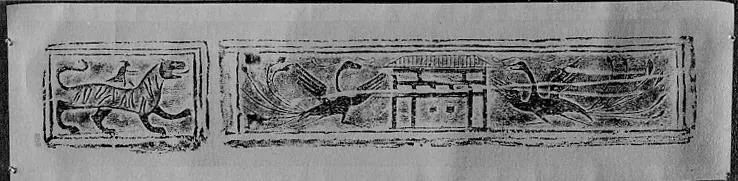
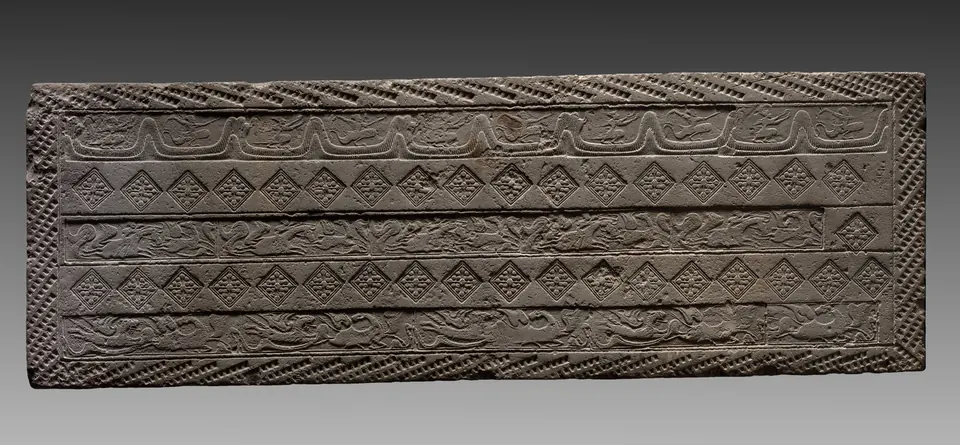
The Met holds a twentieth-century rubbing of a Han tile, ink on paper, 25.1 × 117.2 cm[8]. Compare it with a photograph of a tile and you can see how light and dark trade places.
Compose a brick and take its rubbing
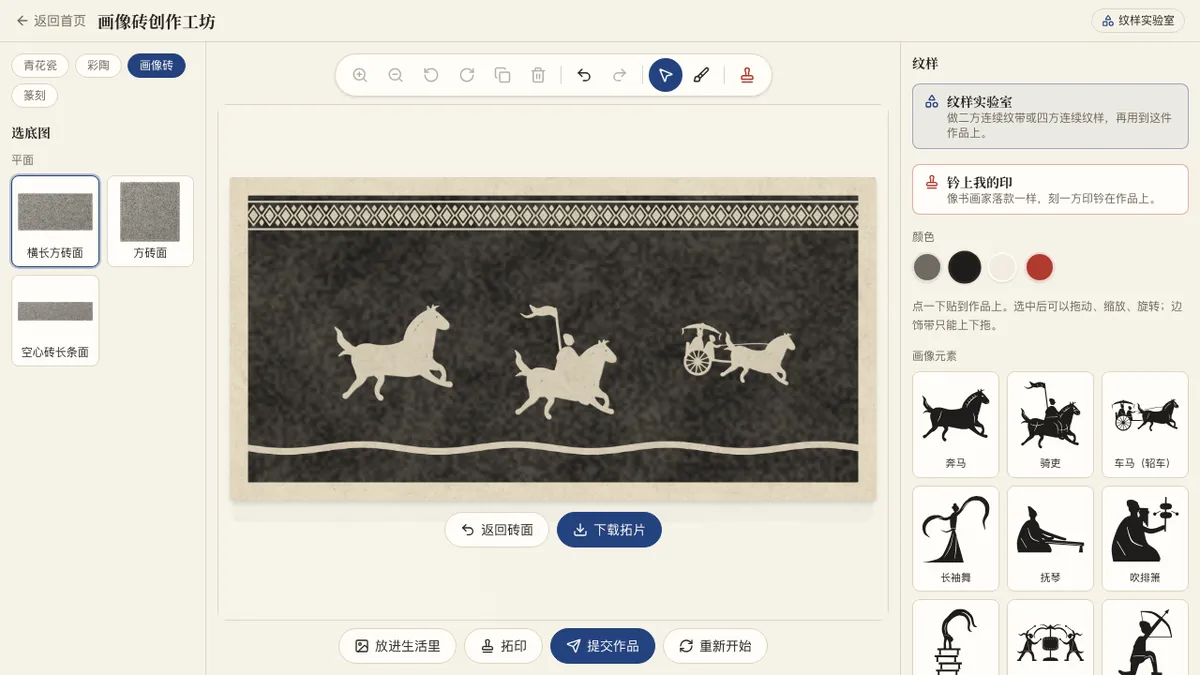
- Choose a face: a long brick, a square brick or a long hollow-brick strip.
- Compose the scene: add a galloping horse, a mounted officer, a chariot, archers or harvesters; frame it with a cloud or lozenge band.
- Take the rubbing: press Rubbing to see it in black and white, then download it.
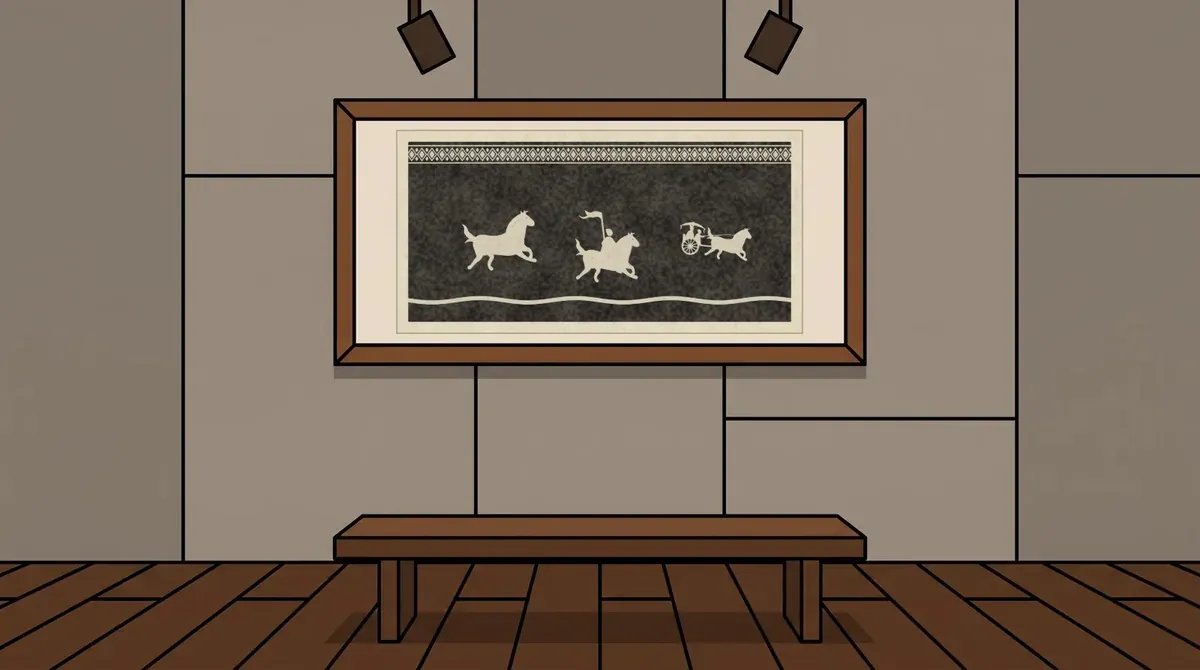
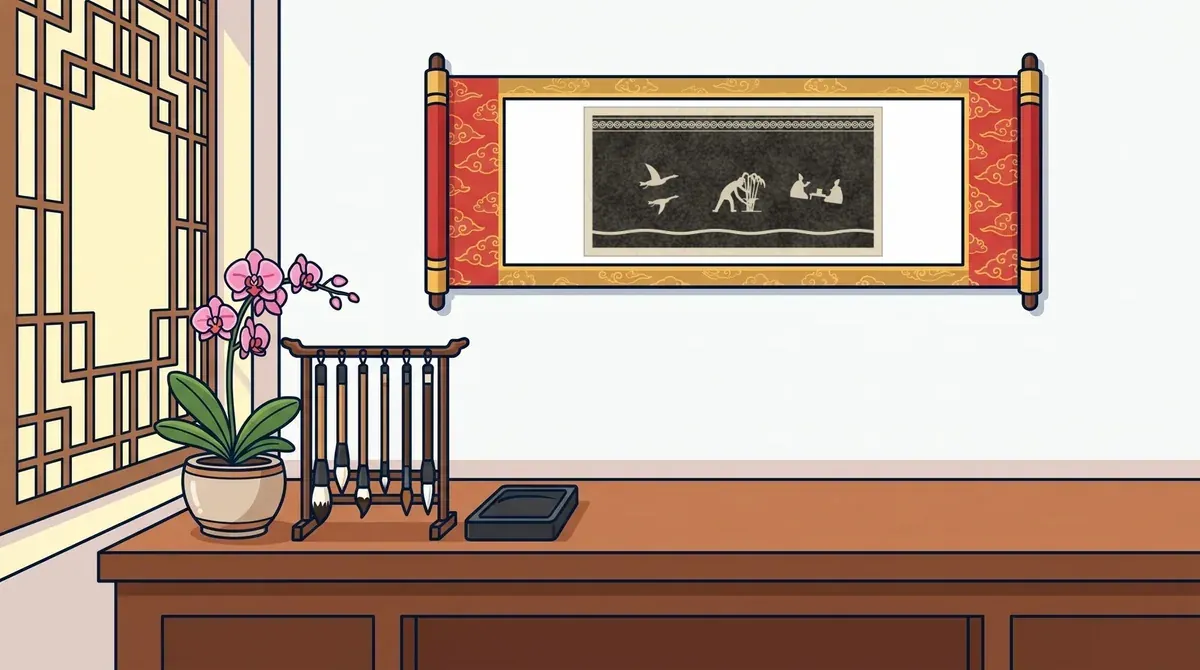
- Place it: hang it on a gallery wall or mount it as a scroll.
- Exhibit it: hand it in to the class 3D gallery. See the sample gallery first.
The rows of repeated bands on Han tiles follow the same logic as frieze patterns.
Price
Every studio can be tried first, with a watermark on the result; taking a work home without it is $4.90. To teach, buy a lesson ($12) or the annual pass ($59 a year: every lesson, and every work without the watermark). New accounts get 60% off in their first hour. See pricing
Images and copyright
- Museum photographs are CC0 open-access images from the Cleveland Museum of Art and The Metropolitan Museum of Art, each credited with accession number.
- The brick-studio motifs are YinSeal’s own redrawings in the Han style; those marked as museum samples are traced from Cleveland’s CC0 stove panels.
- For the Sichuan Museum brick we quote the published description only; we do not use its photograph.
Han pictorial bricks: common questions
- What is the difference between Han pictorial bricks and pictorial stones?
- Pictorial bricks are fired clay; the examples on this page had their images stamped into the surface with moulds. Pictorial stones are carved in stone, in low relief with engraved detail. Cleveland’s hollow-tile doorway column is a brick; its chariot procession frieze is a stone.
- When were Han pictorial bricks made?
- The bricks on this page are all from the Han dynasty. The Cleveland Museum of Art notes that by the first century AD, tombs lined with decorated bricks and tiles had replaced tombs with only rammed-earth walls.
- How is a rubbing of a pictorial brick made?
- A moistened sheet of paper is laid over the surface and tamped with an ink pad. The raised areas turn black; recessed areas and incised lines stay blank.
- What scenes appear on Han pictorial bricks?
- The sourced examples on this page include chariot processions, the dragon, tiger and vermilion bird that guard the directions, and everyday scenes such as hunting by a lotus pond and harvesting rice.
- Can I use these images in class?
- The museum photographs on this page are CC0 open-access images and may be used freely; credit the museum and accession number. The motifs in the YinSeal brick studio are our own redrawings in the Han style.
Each of these Han pictorial bricks is a picture of Han life. Learn to read the chariots, the guardian animals and the rubbings, then compose a brick and take a rubbing of your own, and Han pictorial bricks stop being grey blocks behind museum glass.
It opens with a blank long brick; the motifs are on the right.
Sources
- Cleveland Museum of Art, Hollow Tile: Column from Tomb-Chamber Doorway, 1915.68 (read 2026-11-12)
- Cleveland Museum of Art, Tomb Tile, 1915.73 (read 2026-11-12)
- Cleveland Museum of Art, Panel from Model Cooking Stove: Lancer Jousting with a Tiger, 1925.135 (read 2026-11-12)
- Cleveland Museum of Art, Panel from Model Cooking Stove: Vermilion Bird, 1925.136 (read 2026-11-12)
- Cleveland Museum of Art, Panel from Model Cooking Stove: Fairy Feeding Lingzhi Fungus to a Dragon, 1925.134 (read 2026-11-12)
- Cleveland Museum of Art, Frieze Fragment with Chariot Procession, 1985.73 (read 2026-11-12)
- The Metropolitan Museum of Art, Tomb Panel with Relief of Figures in a Pavilion, 20.99 (read 2026-11-12)
- The Metropolitan Museum of Art, Rubbing of Han Dynasty Tile, 46.82.1 (read 2026-11-12)
- China Daily (chinaservicesinfo.com), Brick relief captures ancient harvest scenes in Sichuan region, 2025-09-23 (read 2026-11-12)