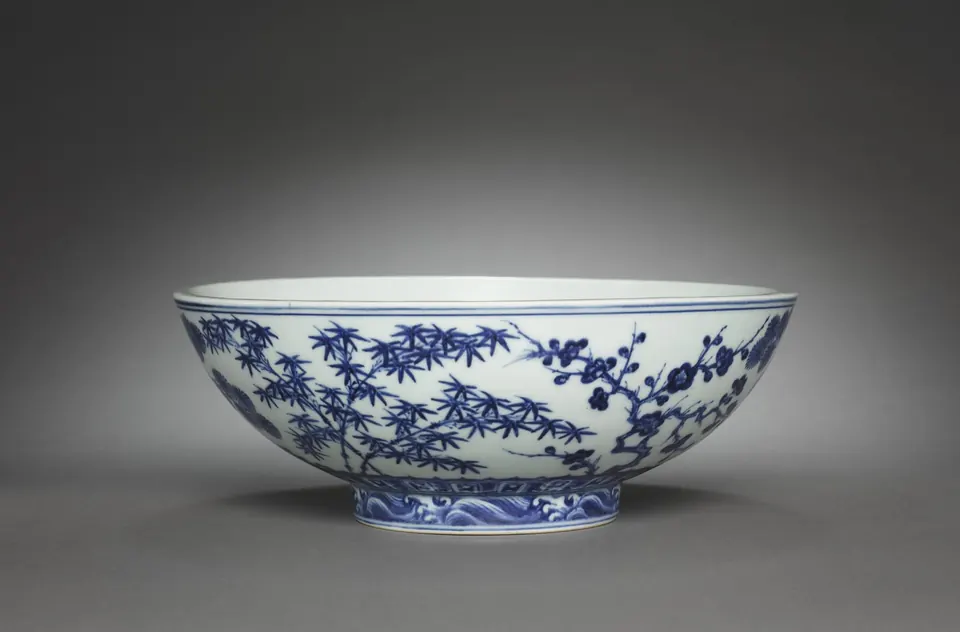
Cleveland Museum of Art · 1953.631 · CC0 public domain · museum page
Learn
Chinese Patterns: 19 Motifs and What We Know
Updated 2026-11-12
Chinese patterns are not one style. A lotus scroll on Ming porcelain, a fish on a 6,000-year-old basin, a chariot on a Han tomb brick and the red square of a seal belong to traditions thousands of years apart. This guide covers four of them, with four or five motifs each. Every meaning given here comes from a museum record or a published source; where the meaning is not documented, we say so. Each section links to a theme page where you can make your own.
How to look at Chinese patterns: bands and fields
Most motifs below are organized in one of two ways. A band (二方连续) repeats a unit along a line: a rim, a neck, the edge of a brick. An all-over pattern (四方连续) fills a surface in both directions. Ask which one you are looking at before asking what a motif means. Why bands and all-overs behave differently.
Blue-and-white porcelain patterns (14th–18th century)
Blue-and-white means cobalt blue painted on a white body, usually under the glaze[1]. On Ming porcelain, decoration sits in horizontal zones, and a few motifs carry most of the meaning.
- Lotus scroll. The Cleveland Museum of Art calls the lotus "a symbol of purity and popular among Chinese literati and in Buddhism"[2].
- Peony scroll. Cleveland’s records give the peony as a symbol of "wealth and honor"[3].
- The Three Friends. Pine, bamboo and plum blossom, the "Three Friends" of winter, stand for "the scholar-gentleman’s ideal of integrity, endurance, loftiness, and purity"[4]. The Xuande bowl at the top of this page carries them.
- Fish and water plants. Fish (yu) sounds like "abundance", so the motif "has an auspicious connotation"[5].
- Ruyi cloud collar. A band of lobed cloud shapes on the shoulder. Ruyi means "as one wishes"[6]. On a 14th-century jar, Cleveland notes that the band "can also be found in Iranian decorative arts of the Ilkhanid period"[7].
One gap: popular sites give the key-fret (回纹) border a meaning, but we found no museum source for one in the Ming period, so we treat it as structure.
Blue-and-white porcelain patterns: motifs, forms and the studio
Neolithic painted pottery patterns (c. 5000–2000 BCE)
Yangshao culture (c. 5000–3000 BCE) of the Yellow River basin is known from sites where painted pottery has been found[8]. The Majiayao cultures (c. 3200–2000 BCE) followed to the northwest, in Gansu and Qinghai[9][30]. Potters burnished the surface and painted it in black and red[10].
- Human face with fish. A basin excavated in 1955 at Banpo, Xi’an, now in the National Museum of China, shows a round face with fish. Such basins were mostly used as lids for children’s burial urns, and the museum gives more than one reading of the image, from a shaman calling on a fish spirit to a fusion of human and fish[11].
- Fish and nets. "The ancient Banpo people painted fish patterns and net patterns on many pots"[11]. The museum calls fish the core Banpo motif, which grew more abstract over time[12].
- Miaodigou petals. On Miaodigou-type basins, dots, hooked leaves and arc-sided triangles leave the unpainted clay showing as flowers. The flowers are formed by the blank spaces[13].
- Majiayao spirals. Spirals are the leading Majiayao motif[9]. A whirlpool-pattern jar in the National Museum of China is known as the "King of Painted Pottery"[14]. Cleveland reads the patterns on its own Majiayao jar as "probably abstract symbols transformed from a bird image"[15].
- Dancers. A basin from Shangsunjiazhai, Qinghai, found in 1973, shows three groups of five dancers holding hands around its inner wall. What the dance depicts is still debated[16].
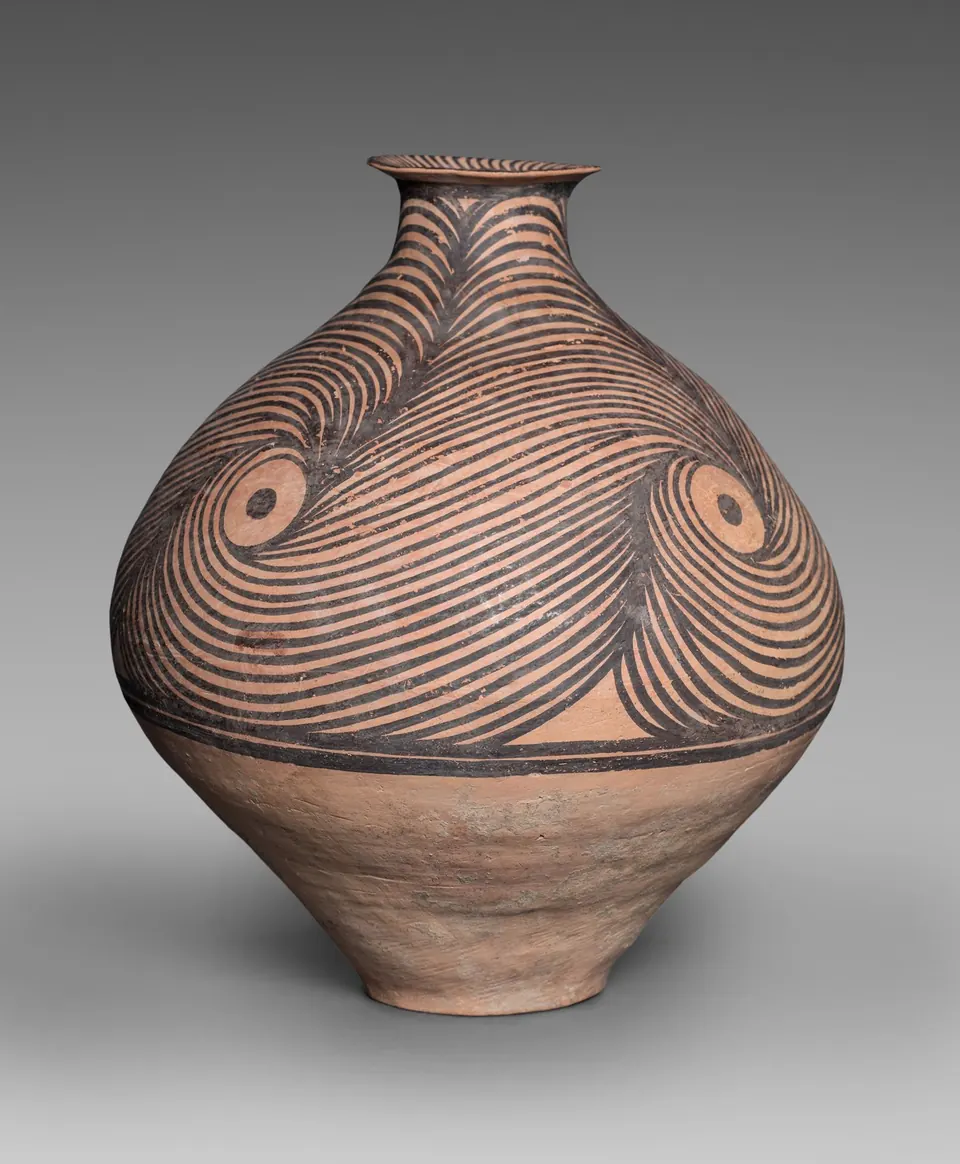
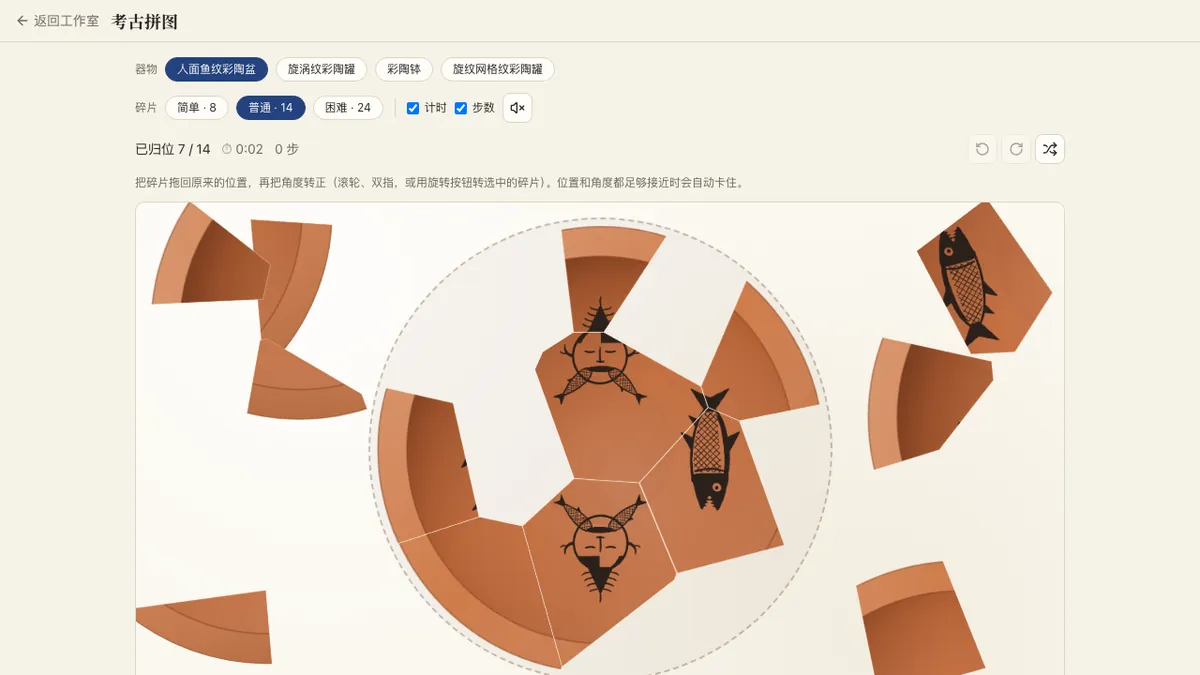
Yangshao culture and the human-face fish basin
Han dynasty brick and stone patterns (206 BCE–220 CE)
By the first century CE, tombs were being "lined with decorated bricks and tiles" instead of rammed-earth walls[17]. Some were stamped or moulded in clay[18]; others were carved in stone[21].
- The Four Spirits. Four animals guard the four directions: the tiger in the west, the dragon in the east, the red bird in the south, and the snake-entwined turtle in the north[19]. They appear on Han mirrors and on mould-made panels of a model stove in Cleveland[20].
- Chariot processions. A carved stone in Cleveland shows "a procession of horse-drawn chariots passing through terrain animated with wild animals and a monkey climbing a tree", in the style of the Wu Family Shrines in Shandong[21]. Britannica dates those shrines to about 147–168 CE[18].
- Performers. A brick from Chengdu in the National Museum of China shows a scarf dance and a juggler with seven balls. The museum calls it valuable evidence for Han music, dance and acrobatics[22].
- Shooting and harvest. Another Chengdu brick has archers shooting at birds with arrows tied to cords in the upper half and a harvest scene below[23].
- Geometric borders. A stamped Han tomb brick at the Penn Museum has "borders… of fret and lozenge designs"[24].
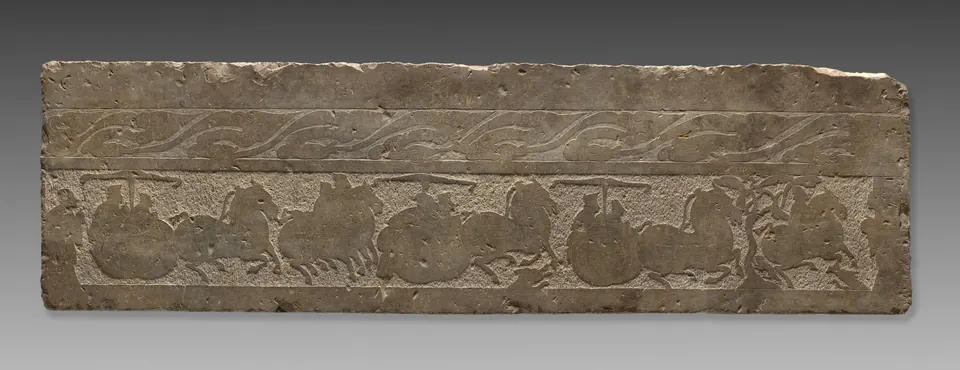
Han reliefs are often studied through rubbings: damp paper is laid on the stone and tamped with ink, so raised areas turn dark and carved lines stay white[21].
Han pictorial bricks: scenes and rubbings
Seal patterns: characters as design
A seal turns a few characters into a compact, single-color design. Seal carving has "a history of more than two thousand years in China"[25].
- Red characters and white characters. Zhuwen seals print the characters in red; baiwen seals print the ground red and leave the characters white[26].
- Seal script. Small-seal script, standardized in the 3rd century BCE, has "lines of even thickness and many curves and circles"[27]. That evenness is what makes a seal face read as pattern.
- Animal knobs. Han seals with "tortoise, chimera, ram, and camel-shaped knobs were popular"[28].
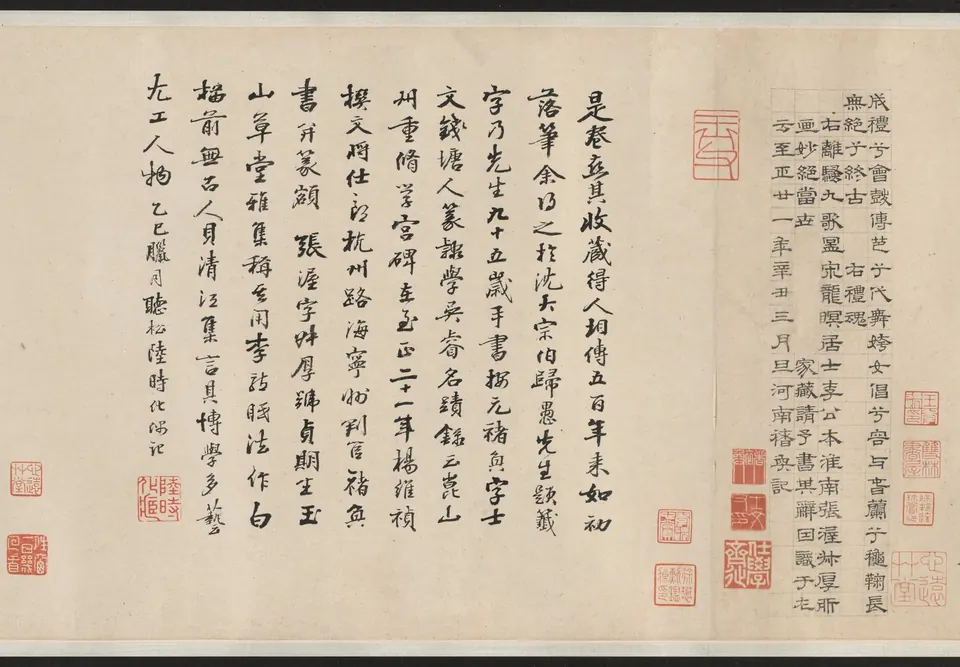
- Collectors’ seals. Seals pile up on a work as it changes hands. One Yuan handscroll in Cleveland carries 47[29].
Chinese name seals: carve a name in seal script · How to read a Chinese seal
Using Chinese patterns in your own work
Three habits keep borrowed motifs honest. First, date and place each one ("Majiayao, Gansu, c. 3000 BCE", not "ancient Chinese"). Second, use the meanings museums document and say so when a meaning is unknown. Third, don’t copy reign marks or invent Chinese-looking characters; carve a name seal instead. To work with the structure itself, the Pattern Lab repeats one unit as a band or an all-over and lets you put the result on a vase or a T-shirt.
Chinese patterns: common questions
- What do Chinese patterns symbolize?
- It depends on the motif and the period. Museums document meanings such as purity for the lotus, wealth and honor for the peony and abundance for the fish, through a pun. Many borders, such as the key fret, have no documented meaning.
- Is Chinese art all about symbolism?
- No. Some motifs carry puns or wishes, but bands, borders and grounds often simply organize a surface. Asking "where does it sit?" is as useful as asking "what does it mean?"
- Where do YinSeal’s patterns come from?
- We draw them ourselves from historical pieces; a few are traced from open-access museum photos. Museum images are CC0 or public-domain photos from the Cleveland Museum of Art and the Met, each with its object number.
Chinese patterns reward slow looking: start with the structure, check the source for each meaning, then make something of your own.
Sources
- V&A, Chinese blue-and-white ceramics (read 2026-11-11)
- Cleveland Museum of Art, Prunus Vase (Meiping) with Blossoming Lotus, 1942.716 (read 2026-11-11)
- Cleveland Museum of Art, 1993.10 (read 2026-11-11)
- Cleveland Museum of Art, Bowl with Decoration of the "Three Friends", 1953.631 (read 2026-11-11)
- Cleveland Museum of Art, Fish, 1977.201 (read 2026-11-11)
- Cleveland Museum of Art, 1970.155 (read 2026-11-11)
- Cleveland Museum of Art, Jar with Lion-Head Handles, 1962.154 (read 2026-11-11)
- Encyclopaedia Britannica, Yangshao culture (Internet Archive copy) (read 2026-11-12)
- Encyclopaedia Britannica, China: 4th and 3rd millennia BCE (Internet Archive copy) (read 2026-11-12)
- Cleveland Museum of Art, Bird-shaped Urn, 2007.276 (read 2026-11-12)
- National Museum of China, Painted Pottery Basin with Fish and Human Face Design (read 2026-11-12)
- National Museum of China, 鱼纹彩陶盆 (basin with fish design) (read 2026-11-12)
- National Museum of China, 彩陶盆 (Miaodigou type) (read 2026-11-12)
- National Museum of China, 涡纹四系彩陶罐 (whirlpool-pattern jar) (read 2026-11-12)
- Cleveland Museum of Art, Jar with Spiral Designs, 2004.64 (read 2026-11-12)
- National Museum of China, 舞蹈纹彩陶盆 (basin with dancers) (read 2026-11-12)
- Cleveland Museum of Art, Hollow Tile: Column from Tomb-Chamber Doorway, 1915.66 (read 2026-11-12)
- Encyclopaedia Britannica, Chinese painting: Qin and Han dynasties (Internet Archive copy) (read 2026-11-12)
- Cleveland Museum of Art, TLV Mirror with Four Spirits and Companions, 1995.301 (read 2026-11-12)
- Cleveland Museum of Art, stove panels, 1925.135 and 1925.136 (read 2026-11-12)
- Cleveland Museum of Art, Frieze Fragment with Chariot Procession, 1985.73 (read 2026-11-12)
- National Museum of China, 观伎画像砖 (brick with performers) (read 2026-11-12)
- National Museum of China, 收获渔猎画像砖 (brick with shooting and harvest) (read 2026-11-12)
- Penn Museum, Tomb Brick, C691 (read 2026-11-12)
- The Metropolitan Museum of Art, Album of Seal Carvings by Fu Baoshi (Internet Archive copy, 2024-11-12) (read 2026-11-11)
- Virginia Museum of Fine Arts, Create a Chinese Seal (Internet Archive copy, 2025-03-18) (read 2026-11-11)
- Encyclopaedia Britannica, Chinese calligraphy (Internet Archive copy) (read 2026-11-11)
- Minneapolis Institute of Art, seal, 2000.38.6 (read 2026-11-12)
- Cleveland Museum of Art, Nine Songs, 1959.138 (read 2026-11-11)
- National Museum of China, 彩陶鼓 (painted pottery drum, Majiayao culture) (read 2026-11-12)