How to Read a Chinese Seal (Chop): Five Questions to Ask
How to read a Chinese seal or chop: red or white characters, seal script, whose seal it is, where it sits, and a museum scroll to practise on.
You don't need to read seal script to learn a lot from a Chinese seal. Learning how to read a Chinese seal starts with five questions anyone can answer by looking: are the characters red or white, what script are they in, whose seal is it, where does it sit on the work, and what shape and material is it? This guide works through each with museum examples, then puts all five to work on a 14th-century painting in Cleveland that carries 19 seals.
What a Chinese chop is: seal, chop and stamp
"Chop" is not a Chinese word. Merriam-Webster defines it as "a seal or official stamp or its impression", from Hindi chāp and Urdu chhāp, "stamp", first recorded in 1614 [1]. In Chinese the object is a 印 yìn or 章 zhāng, and the art is seal carving.
Chinese seals were used "by artists and authors to sign art, letters, and official documents but also by art collectors to document works in their collections" [2]. The Metropolitan Museum puts the art of seal carving at "more than two thousand years" old, with seals bearing "personal names, official titles, or poetic phrases" collected "as a special form of calligraphy" [3]. In 2009 UNESCO inscribed the art of Chinese seal engraving on its Representative List of the Intangible Cultural Heritage of Humanity [4].
Question 1: Red characters or white characters?
This is the first thing to check, and it tells you how the stone was cut.
- Zhuwen (朱文, "red characters"). The carver cuts away the background and leaves the characters standing, so they print red on the paper's colour.
- Baiwen (白文, "white characters"). The carver cuts the characters into the stone, so the ground prints red and the characters show white.
The Virginia Museum of Fine Arts puts it this way: "Zhuwen seals leave an imprint of Chinese characters in red paste… Baiwen seals print the inverse, leaving an imprint of the background in red paste, showing the characters in negative space" [2]. Britannica notes that the characters "most often appear in line, but they are sometimes reserved against the inked ground" [5].
Either way, the face is carved in reverse. UNESCO describes the process: "The design is first sketched on paper, and then engraved on stone, in reverse, with a knife." [4]
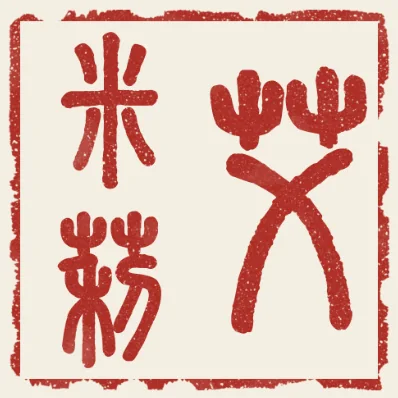
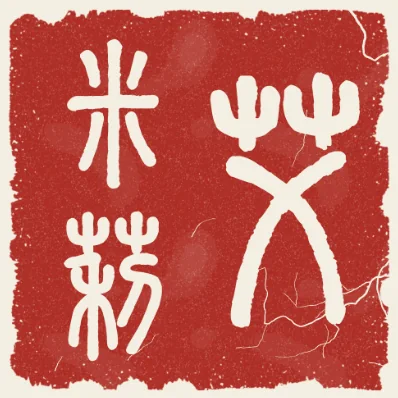
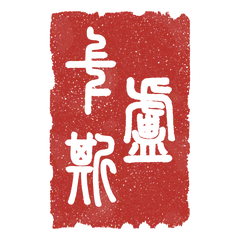
Both are our own seals for the name Emily (艾米莉), carved in the YinSeal seal studio.
Question 2: What script is it in?
Most seals are not in the script you see in a newspaper. Seal script got its name, the Met explains, "because it remained the script type used on personal seals" [6]. Small-seal script was standardized when China was first unified in the 3rd century BCE, and it "is characterized by lines of even thickness and many curves and circles" [7]. Britannica notes that "modern seals generally employ the 'small seal' character" [5].
So a reader of modern Chinese may still need a seal-script dictionary. A Cleveland inkstone makes the difference visible on one object: its base has "four characters in seal script (zhuanshu) expressing auspicious, or favorable wishes", while the characters on the side "in standard script (kaishu) record the name of the workshop" [8].
What about reading order? There is no single safe rule. Cleveland describes one seal-script calligraphy set as running "starting at the top right and ending at the bottom left" [9], while the Palace Museum notes that the characters on one Warring States jade seal "are to be read from left to right" [10]. When you can, check a catalogue entry.
Question 3: Whose seal is it, and what kind?
The Hong Kong Museum of Art divides the seals on paintings and calligraphy into two families: "One is the artist's seal, representing the artist's signature, and the other is the seal of the connoisseur or collector, which serves as a record of viewing or ownership of the work." By content, they can be "further classified into name seals, studio seals, motto seals, diagram seals and so on." [11]
- Name seals. Private seals are "commonly square and reading merely 'seal of so and so'" [5]. Cleveland's Bamboo in Snow (1818) carries exactly that: 洪範之印, "Seal of Hong Fan" [12].
- Studio-name and art-name seals. "A man might own scores of seals, using his many sobriquets, especially those suggesting unworldly and rustic tastes." [5] The same painting has a second seal, 石農詩畫, "A poetic painting by Shi Nong"; the museum notes that Shi Nong was the artist's hao, or studio name [12]. The Smithsonian's National Museum of Asian Art holds a group selected from 113 personal seals carved for one artist and scholar, Xie Zhiliu [13].
- Phrase seals. In Chinese these are 闲章 xiánzhāng, sometimes translated "leisure seals"; museums call them "motto seals" [11] or seals bearing "commendatory phrases" [14]. A 14th-century painting in Cleveland lists an artist's seal that is a line of verse: "People allude to the Grotto of the Peach Blossoms; it is not likely that such a flowering branch would exist in our world." [15]
- Collectors' seals. The collector Low Chuck-tiew "had over 50 seals each bearing a different inscription, such as 'viewed by the owner of Xubaizhai'" [11].
- Imperial seals. The imperial seal "was traditionally large and square, made of jade or ivory" [5].
Question 4: Where is it on the work?
Seals were known long before they appeared on art: "it was not until the Tang dynasty (AD618-907) that they were first applied to paintings and calligraphy", and they became popular in the Song [11].
The artist's seal sits with the signature. On a fan by the Ming painter Chen Chun, the Minneapolis Institute of Art notes that he placed his seal "Daofu", an alternate name, "after both the painting's title and the same name written in the right corner" [16]. Catalogue entries record positions too, such as "Artist's seal at lower left corner" [17].
Seals also do compositional work. The Hong Kong Museum of Art notes that "they can enhance the balance of the composition and they can keep the work intact", and that long handscrolls were stamped in the margins with "indent seal impressions" (qifeng yin) [11].
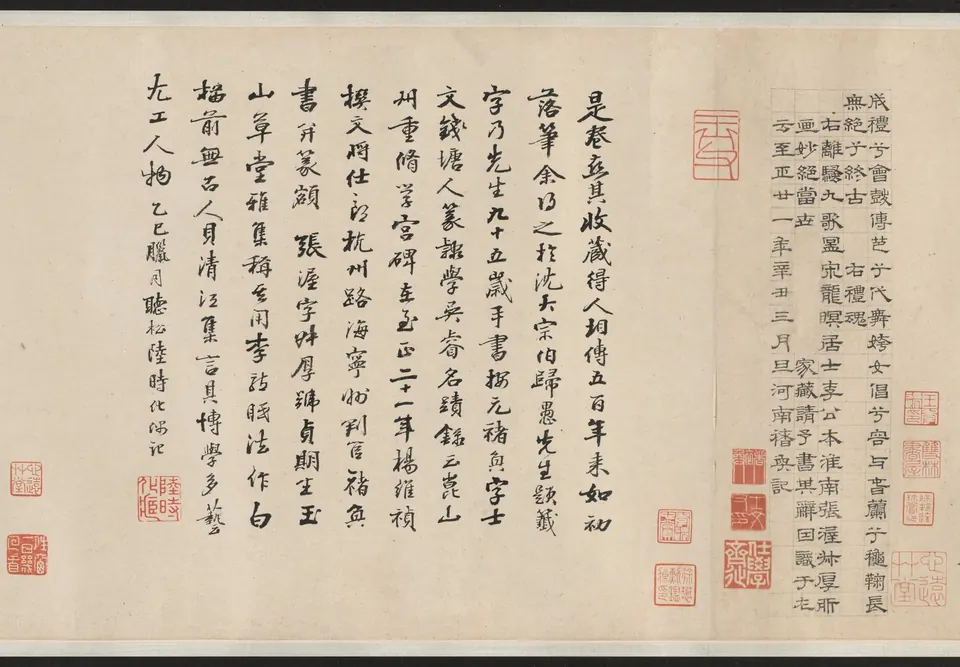
Collectors' seals gather around the image and on the mounting. On the same Chen Chun fan, three seals of the Qianlong emperor sit "one placed beside his signature and the other two positioned on either side of the fan" [16]. The Met calls the seals and inscriptions that later owners added to a painting and its borders "a distinctive feature of Chinese collecting and connoisseurship" [18]. Over centuries they pile up: Cleveland's Nine Songs handscroll of 1361 carries 47 seals [19], and a Mi Fu album in San Francisco gained "three colophons and 193 seal impressions" from later collectors and viewers [20]. A Dong Qichang landscape in Cleveland carries 14 seals of the Qianlong emperor, and also a seal reading "Seal of the King of Joseon" [21].
Question 5: What shape, and what is it made of?
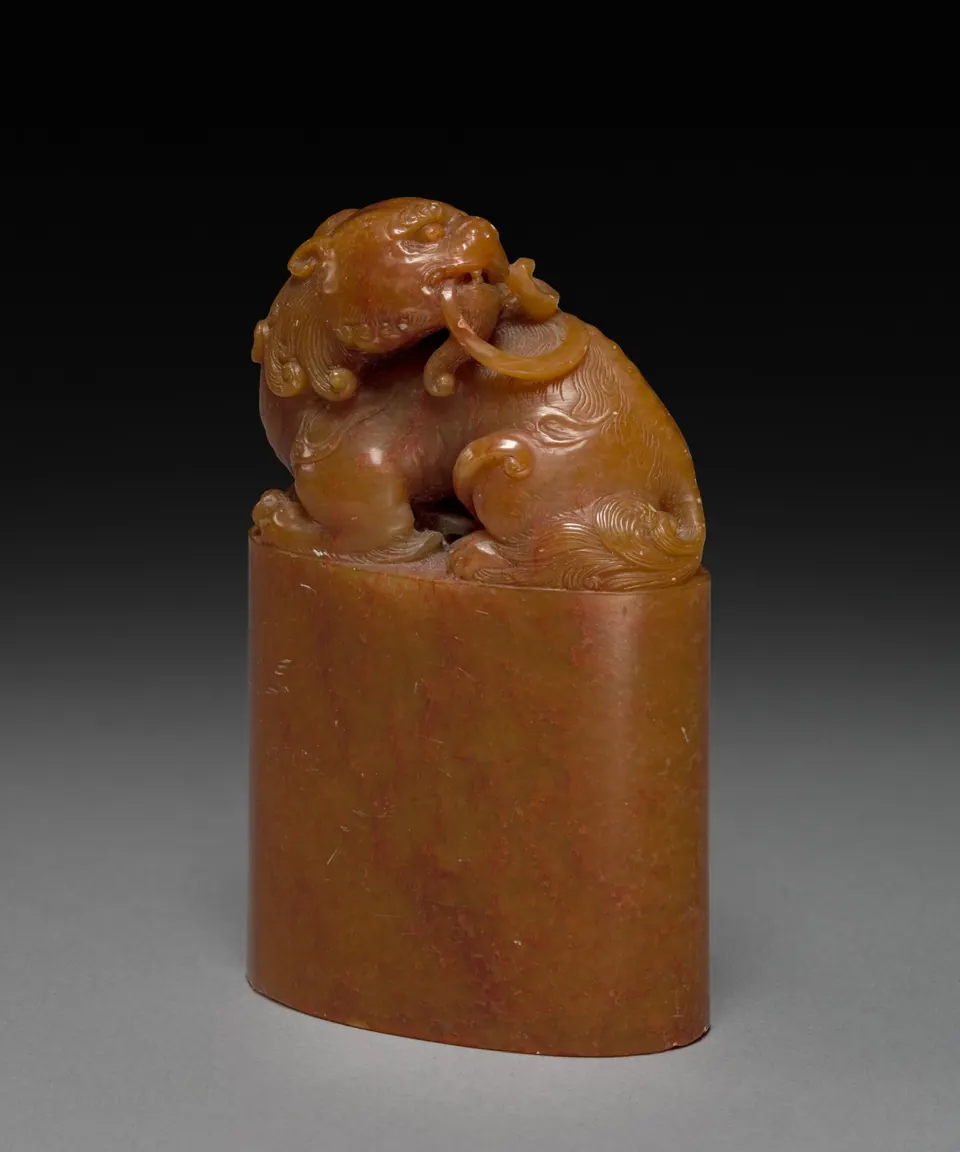
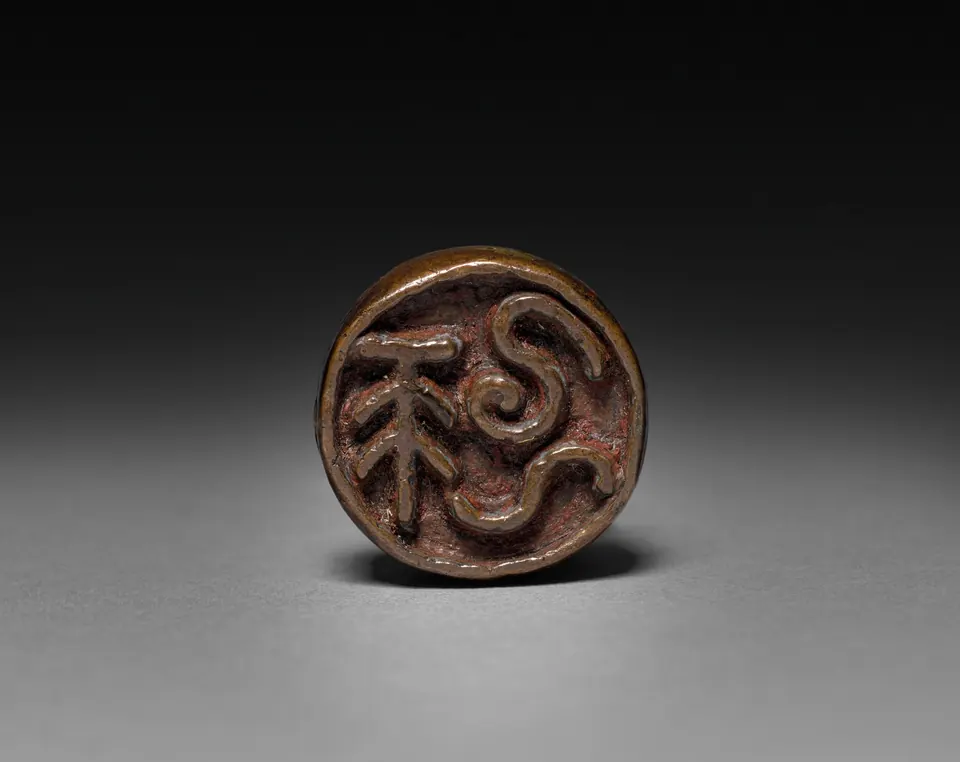
Most private seals are square [5], but other shapes exist: the Palace Museum shows a set of three connected Qianlong seals whose middle one is round [22], and a Qianlong-period seal in Cleveland has an elliptical face [28]. The Hong Kong Museum of Art lists shape, together with "the lettering style and the colour of the seal impression", as things to study when examining a seal [11].
The material changes the line. The Minneapolis Institute of Art explains that "Bronze and jade were commonly used for seals before the Yüan dynasty (1280–1368), but these materials proved too hard to be carved by anyone but professionals", and that in the Ming, "soapstone became the preferred material of the literati" [23]. The Met dates the shift to soft stones to the late 16th century [24]. Han seals often had a sculpted knob: seals "with tortoise, chimera, ram, and camel-shaped knobs were popular" in the Eastern Han [25]. The red paste itself is made from powdered cinnabar [26].
Practice: how to read a Chinese seal on a Yuan painting
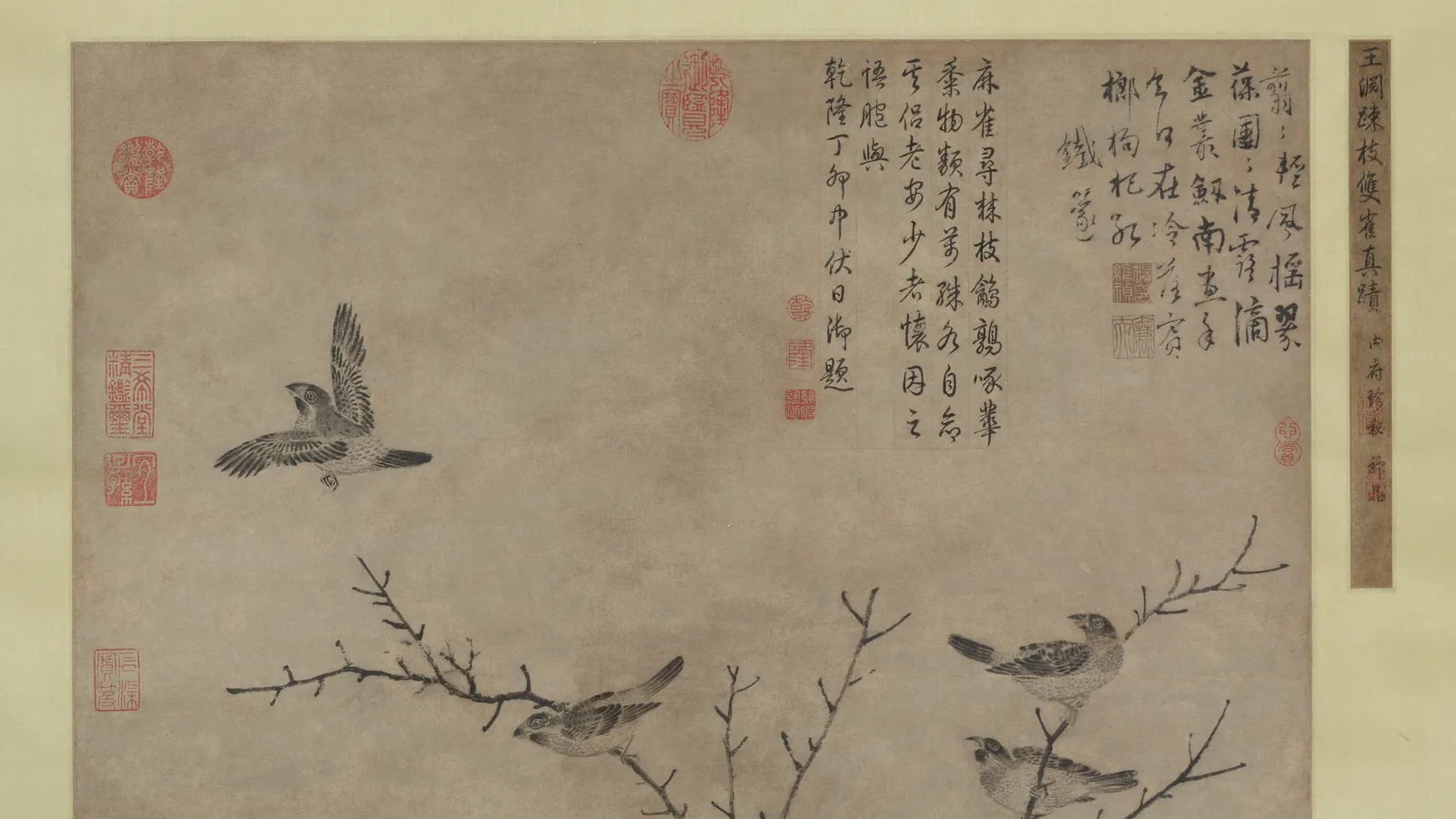
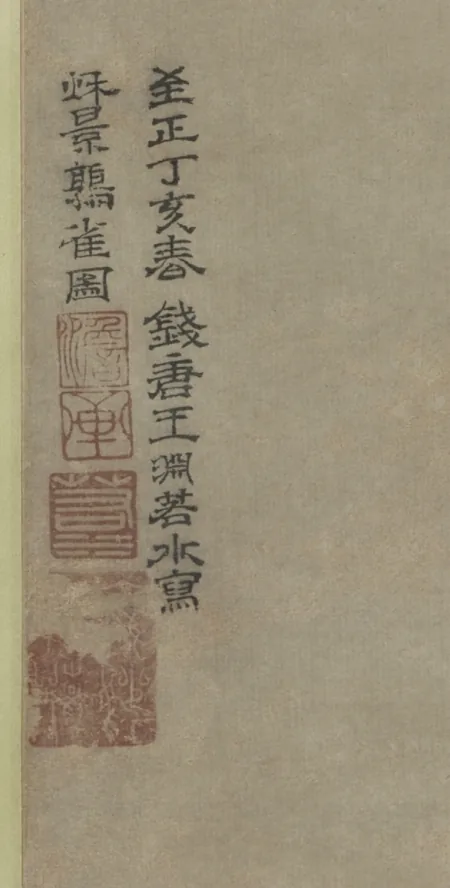
Wang Yuan's Quails and Sparrows in an Autumn Scene, dated 1347, is in the Cleveland Museum of Art, and its catalogue record lists every seal [27]. Try the five questions on it.
- The artist's group. Wang Yuan's inscription signs the painting "Wang Yuan, Ruoshui of Qiantang", followed by three seals: 澹轩 Danxuan, 若水 Ruoshui and 墨妙筆精 Mo miao bi jing. One seal repeats the name in the signature; another is a four-character phrase, the kind museums call a motto seal.
- A poet's response. A poem by Yang Weizhen (1296–1370) follows with two seals, 杨维桢印 Yang Weizhen yin ("Seal of Yang Weizhen", the standard name-seal pattern) and 廉夫 Lianfu.
- The collectors. "1 inscription and 10 seals of the Qianlong emperor (r. 1736–95)", and "4 seals of Zhang Heng 張珩 (1915–1963)".
That is 19 seals on one work, spanning about six centuries. Without reading a single character of seal script, you can now say who signed it, who answered it, and who owned it.
How to read a Chinese seal from the inside: carve one yourself
The fastest way to understand a seal is to make one. In the YinSeal seal studio you type your English name and choose from its usual Chinese renderings, each character shown with its pinyin and a plain meaning. Then you choose red or white characters and a shape (square, rectangle, round, oval, gourd, or a Qin-style grid), and the studio shows the reversed stone beside the print. There are also picture seals of animals. You can stamp the seal on anything else you make in the studio. For the craft itself (layout, stones and how a name seal is designed), see our guide to Chinese name seals. Teaching a class? In our Lunar New Year art lesson, students carve a name seal and design a plate that carries a wish.
FAQ
- What is a Chinese chop?
- A seal or its red impression. "Chop" is an English word, from Hindi and Urdu words for "stamp" [1]; in Chinese the seal is a 印 yìn or 章 zhāng.
- How to read a Chinese seal if you can't read seal script?
- Start with what you can see: red or white characters, the shape, and where the seal sits. Then look for a museum record or catalogue entry, which often transcribes and translates each seal, as Cleveland does for Wang Yuan's painting [27].
- Can I read a Chinese seal if I read modern Chinese?
- Often not at first sight. Most seals use small-seal script [5], which differs from the standard script used today [8]. A seal-script dictionary helps.
- Is it all right to have a Chinese name seal if I'm not Chinese?
- That is a judgment call, not a fact. Our view: treat it as a translation, not decoration. Know what every character means, and have it checked by a fluent reader if you can.
Once you know how to read a Chinese seal, a painting's red marks stop being decoration and start reading like a record: who made it, who admired it, and who owned it.
Sources
Merriam-Webster, "chop" (noun 2): "a seal or official stamp or its impression"; etymology "Hindi chāp & Urdu chhāp stamp"; first known use "1614". https://www.merriam-webster.com/dictionary/chop (Wayback 20251229145634; accessed 2026-11-12)
Virginia Museum of Fine Arts, "Create a Chinese Seal": "Chinese seals were used not only by artists and authors to sign art, letters, and official documents but also by art collectors to document works in their collections."; "Zhuwen seals leave an imprint of Chinese characters in red paste… Baiwen seals print the inverse, leaving an imprint of the background in red paste, showing the characters in negative space…" http://web.archive.org/web/20250318195137/https://vmfa.museum/interactives/beyond-the-walls/seal (Wayback 20250318195137; accessed 2026-11-11)
The Metropolitan Museum of Art, Album of Seal Carvings by Fu Baoshi: "The art of seal carving has a history of more than two thousand years in China, and finely carved examples bearing personal names, official titles, or poetic phrases have long been collected and admired as a special form of calligraphy." https://www.metmuseum.org/art/collection/search/76642 (Wayback 20241112063826; accessed 2026-11-11)
UNESCO Intangible Cultural Heritage, "Art of Chinese seal engraving": "Inscribed in 2009 (4.COM) on the Representative List of the Intangible Cultural Heritage of Humanity"; "The design is first sketched on paper, and then engraved on stone, in reverse, with a knife." https://ich.unesco.org/en/RL/art-of-chinese-seal-engraving-00217 (accessed 2026-11-12)
Britannica, "sigillography: Chinese and Japanese seals": "commonly square and reading merely 'seal of so and so' (XX chih yin)"; "A man might own scores of seals, using his many sobriquets, especially those suggesting unworldly and rustic tastes."; "The characters most often appear in line, but they are sometimes reserved against the inked ground."; "modern seals generally employ the 'small seal' character (chuan shu)"; "The imperial hsi (called pao beginning in the T'ang period, ad 618–907) was traditionally large and square, made of jade or ivory." https://www.britannica.com/topic/sigillography/Chinese-and-Japanese-seals (Wayback 20251211135303; accessed 2026-11-12)
The Metropolitan Museum of Art, "Chinese Calligraphy" (Heilbrunn Timeline essay): "it evolved into 'seal' script, so named because it remained the script type used on personal seals." https://www.metmuseum.org/toah/hd/chcl/hd_chcl.htm (Wayback 20250206140545; accessed 2026-11-12)
Britannica, "Chinese calligraphy": "When China was united for the first time, in the 3rd century bce, the bronze script was unified and regularity enforced."; "Small-seal script is characterized by lines of even thickness and many curves and circles." https://www.britannica.com/art/Chinese-calligraphy (Wayback 20261103072249; accessed 2026-11-11)
Cleveland Museum of Art, Inkstone in the Shape of a Roof Tile with Seal Script Characters, 2023.50: "The base shows four characters in seal script (zhuanshu) expressing auspicious, or favorable wishes, while the characters on the side in standard script (kaishu) record the name of the workshop and that of the collector's studio." https://clevelandart.org/art/2023.50 (accessed 2026-11-12)
Cleveland Museum of Art, Yang Yisun, On Happiness, Calligraphy in Seal Script Style, 1999.174: "Yang Yisun transcribed this ancient text on six narrow scrolls, starting at the top right and ending at the bottom left." https://clevelandart.org/art/1999.174 (accessed 2026-11-12)
The Palace Museum (Beijing), via Google Arts & Culture, "He Shan's green jade seal in the shape of a dancer": the characters "are to be read from left to right." https://artsandculture.google.com/asset/he-shan-s-green-jade-seal-in-the-shape-of-a-dancer/9wHSDITWhvvp_Q (accessed 2026-11-12)
Hong Kong Museum of Art, "Vermillion Impressions: Chinese Painting and Calligraphy Seals": "One is the artist's seal, representing the artist's signature, and the other is the seal of the connoisseur or collector, which serves as a record of viewing or ownership of the work."; "further classified into name seals, studio seals, motto seals, diagram seals and so on."; "it was not until the Tang dynasty (AD618-907) that they were first applied to paintings and calligraphy"; "they can enhance the balance of the composition and they can keep the work intact."; "indent seal impressions" (qifeng yin); "had over 50 seals each bearing a different inscription, such as 'viewed by the owner of Xubaizhai'"; "studying the shape, the lettering style and the colour of the seal impression". https://hk.art.museum/en/web/ma/resources/archive/education-resources/resources/vermillion-impressions-chinese-painting-and-calligraphy-seals.html (accessed 2026-11-12)
Cleveland Museum of Art, Hong Fan, Bamboo in Snow, 1818, 2023.161: "Artist's seal: Seal of Hong Fan. ('Hong Fan zhi Yin')"; "Artist's seal: A poetic painting by Shi Nong."; "'Shi Nong' was the hao or studio name/epithet of the artist Hong Fan." https://clevelandart.org/art/2023.161 (accessed 2026-11-12)
Smithsonian National Museum of Asian Art, F1998.76.34: "selected from a group of 113 personal seals created for the late artist and scholar Xie Zhiliu (1910-1997) by his protégé the seal carver Wu Zijian". https://asia.si.edu/object/F1998.76.34/ (Wayback 20220705061945; accessed 2026-11-12)
Smithsonian National Museum of Asian Art, F1978.51a-f: "Seals, which can bear personal names or commendatory phrases, are symbols of ownership and authority as well as aesthetic objects". https://asia.si.edu/object/F1978.51a-f/ (Wayback 20220517171216; accessed 2026-11-12)
Cleveland Museum of Art, Yintuoluo, The Second Coming of the Fifth Patriarch, c. mid-1300s, 1967.211: "Artist's seal: People allude to the Grotto of the Peach Blossoms; it is not likely that such a flowering branch would exist in our world." https://clevelandart.org/art/1967.211 (accessed 2026-11-12)
Minneapolis Institute of Art, Chen Chun, Deep Fragrance in the Valley of the Void, c. 1530, 96.30.2: "Chen stamped this painting with the signature seal 'Daofu,' an alternate name, placing it after both the painting's title and the same name written in the right corner. The work also bears three collector's seals of the Qianlong emperor (reign 1736–95)—one placed beside his signature and the other two positioned on either side of the fan." https://collections.artsmia.org/art/5047 (accessed 2026-11-12)
Cleveland Museum of Art, attributed to Tang Yin, Listening to the Qin, 1977.199: "Artist's seal at lower left corner: Wu [remainder cut off]." https://clevelandart.org/art/1977.199 (accessed 2026-11-12)
The Metropolitan Museum of Art, Night-Shining White, 1977.78: "The seals and inscriptions added to the painting and its borders by later owners and appreciators are a distinctive feature of Chinese collecting and connoisseurship." https://www.metmuseum.org/art/collection/search/39901 (Wayback 20250311160723; accessed 2026-11-12)
Cleveland Museum of Art, Nine Songs, dated 1361, 1959.138: "7 colophons and 47 seals…" https://clevelandart.org/art/1959.138 (accessed 2026-11-11)
Asian Art Museum (San Francisco), Calligraphy workshop PDF, on the Mi Fu album 2004.31: "Later collectors and viewers added three colophons and 193 seal impressions." https://education.asianart.org/wp-content/uploads/sites/6/2019/09/Calligraphy-workshop.pdf (accessed 2026-11-11)
Cleveland Museum of Art, Dong Qichang, River and Mountains on a Clear Autumn Day, c. 1624–27, 1959.46: "2 inscriptions and 14 seals of the Qianlong 乾隆 emperor (r. 1736–95)"; "Seal of King Seonjo… 'Seal of the King of Joseon'". https://clevelandart.org/art/1959.46 (accessed 2026-11-12)
The Palace Museum (Beijing), via Google Arts & Culture, "The Qianlong Emperor's Three Connected Seals": "The middle, rounded seal is inscribed with two characters translated as 'Rejoice in Heaven'". https://artsandculture.google.com/asset/the-qianlong-emperor-s-three-connected-seals/hwEyrMwftcb3jw (accessed 2026-11-12)
Minneapolis Institute of Art, seal, 50.46.397: "Bronze and jade were commonly used for seals before the Yüan dynasty (1280–1368), but these materials proved too hard to be carved by anyone but professionals."; "In the Ming dynasty, soapstone became the preferred material of the literati." https://collections.artsmia.org/art/1073 (accessed 2026-11-12)
The Metropolitan Museum of Art, Pair of Square Seals with Cloud and Rock Pattern, 2007.52a, b: "Seal carving became an important branch of Chinese literati art during the late sixteenth century, when artists began using soft stones, or soapstones, for the craft." https://www.metmuseum.org/art/collection/search/73666 (Wayback 20250612170116; accessed 2026-11-11)
Minneapolis Institute of Art, seal, 2000.38.6: "Seals with tortoise, chimera, ram, and camel-shaped knobs were popular and have been excavated from Eastern Han tombs." https://collections.artsmia.org/art/11860 (accessed 2026-11-12)
Smithsonian National Museum of Asian Art (Freer), Seal paste container and stand, F1980.89a-f: "Mostly red in color, seal paste is made from powdered cinnabar, moxa-leaf fiber, and dehydrated vegetable oil." https://asia.si.edu/object/F1980.89a-f/ (Wayback 20221205192455; accessed 2026-11-11)
Cleveland Museum of Art, Wang Yuan, Quails and Sparrows in an Autumn Scene, 1347, 1997.91, inscriptions: "Artist's inscription, signature, and 3 seals: … Wang Yuan, Ruoshui of Qiantang, drew this picture… [seals] Danxuan; Ruoshuii; Mo miao bi jing." (Chinese: 澹轩; 若水; 墨妙筆精); "1 poem and 2 seals of Yang Weizhen (1296–1370)… [Seals] Yang Weizhen yin; Lianfu" (杨维桢印; 廉夫); "1 inscription and 10 seals of the Qianlong emperor (r. 1736–95)"; "4 seals of Zhang Heng 張珩 (1915–1963)". https://clevelandart.org/art/1997.91 (accessed 2026-11-12)
Cleveland Museum of Art, Seal with Reclining Qilin, 1952.494, tianhuang stone, 1736–95: "The elliptical seal has three characters in archaic script enclosed by two dragons." https://clevelandart.org/art/1952.494 (accessed 2026-11-11)