Frieze Groups and 17 Wallpaper Groups, With Chinese Examples
Frieze groups and the 17 wallpaper groups for design students: the four moves, why there are only 7 and 17, and Chinese lattices to test them on.
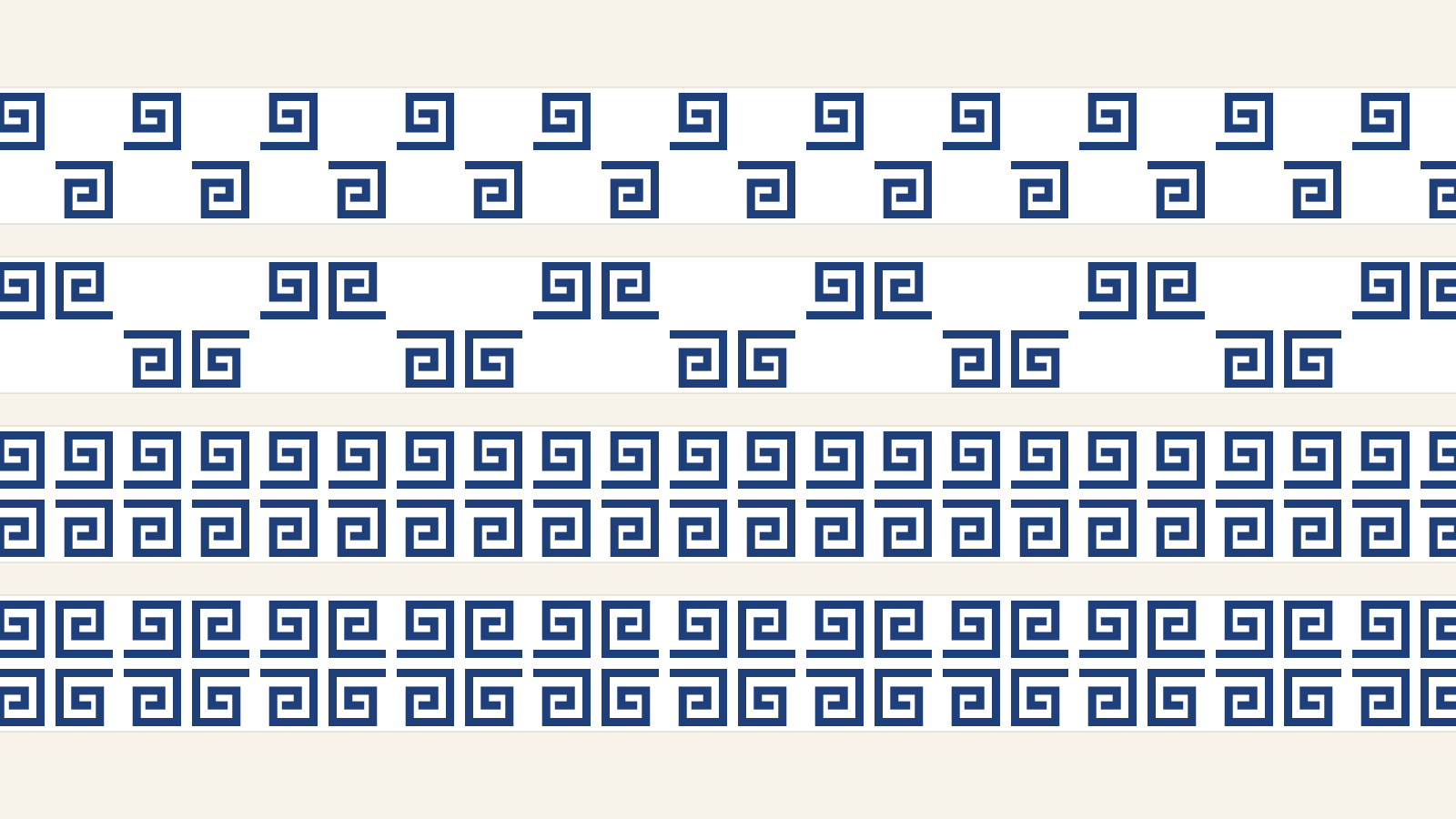
Designers say border and all-over. Chinese pattern books say 二方连续 and 四方连续. Mathematicians say frieze and wallpaper. The distinction is the same in all three: does one unit repeat along a line, or across a plane? What surprises most students is the next step. However inventive the motif, a band belongs to one of just seven frieze groups, and an all-over to one of the 17 wallpaper groups. This post explains why, with Chinese examples and a lab where you can build them. For the basics of bands and all-overs first, see our guide to band and all-over patterns.
Frieze groups and wallpaper groups: the one-line difference
Doris Schattschneider's classic paper puts it precisely: a design that repeats under the multiples of a single translation is a frieze, or border ornament, and one that repeats at regular intervals in two directions is a wallpaper pattern [1].
Chinese design teaching uses the same split. The Palace Museum's glossary defines 二方连续 (literally "continuous in two directions") as a band pattern, made by repeating one unit left and right, or up and down [2]. A design textbook from Tsinghua University Press defines 四方连续 ("continuous in four directions") as a unit repeated outward on all sides, and notes it is common on printed cloth and wallpaper [3].
You can see both on Chinese objects:
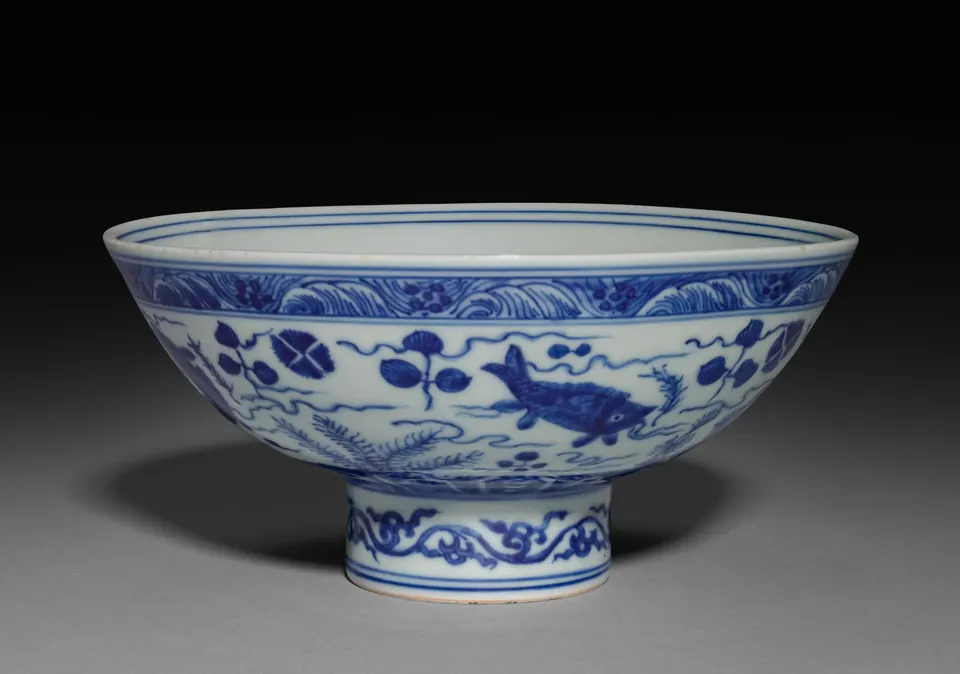
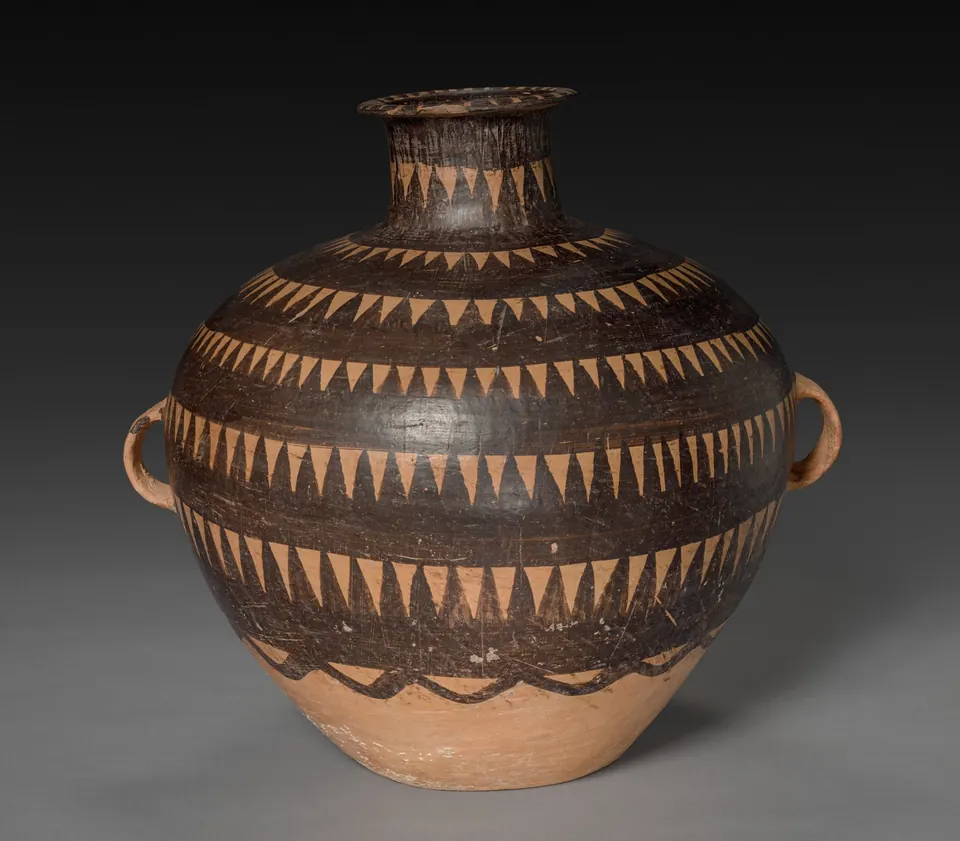
- Bands. A Xuande-period vase in the V&A is decorated "round the neck and the foot with key-fret bands" [4]. The Palace Museum describes bands of soft arcs and bold dots, set out as 二方连续, as a typical Majiayao composition, thousands of years earlier [2].
- All-overs. A Kangxi jar in the V&A has "prunus blossoms and branches against a background of cracked ice", which, the museum suggests, may mean it was meant as a New Year present [5]. Cleveland has a Qing bowl with peony sprays on a "diaper ground" [6], and on a Shang bronze wine container in Cleveland, crested birds sit "against the dense background of spiral patterns (leiwen)" [7].
Four moves that leave a pattern unchanged
A symmetry of a pattern is a move that lands the pattern exactly on itself. In the plane there are only four kinds of rigid move: "every rigid motion is either a rotation, translation, reflection or glide reflection" [8].
- Translation: slide the whole pattern a fixed distance in a fixed direction.
- Rotation: "stick a pin through some point of the paper and turn the whole sheet around the pin" [8].
- Reflection: fold along a line, so each point lands on its mirror image [8].
- Glide reflection: slide along a line, then reflect in that same line [8]. Footprints in sand are the standard example: left, right, left, right.

Every repeating pattern has translations. What tells patterns apart is which of the other three moves they also have.
The 7 frieze groups
A band can only be turned or flipped in a few ways that keep it on its own line. Donald Crowe lists them: a reflection in the band's centre line, reflections in lines across the band, half-turns, and glide reflections along it [8]. Combine those in every consistent way and you get exactly seven frieze groups [9]; a proof is given in Washburn and Crowe's Symmetries of Culture [10].
John Conway named them after footsteps, which makes them easy to remember [11]. In the table, a letter repeated along a line stands in for the unit. The last column shows how to build each one in the YinSeal Pattern Lab, which has three band arrangements: Shift, Mirror, and Alternate up/down.
| Conway name | Crystallographic name | Moves besides sliding | Letter example | In the Pattern Lab |
|---|---|---|---|---|
| hop | p1 | none | L L L L | Shift, with an asymmetric unit |
| step | p11g | glide reflection | L Γ L Γ | Alternate up/down, asymmetric unit |
| sidle | p1m1 | mirrors across the band | L ⅃ L ⅃ | Mirror, asymmetric unit |
| spinning hop | p2 | half-turns | N N N N | Shift, with a unit that looks the same upside down |
| spinning sidle | p2mg | mirrors across, half-turns, glide | V Λ V Λ | Alternate up/down, with a left-right symmetric unit |
| jump | p11m | mirror along the centre line | E E E E | Shift, with a top-bottom symmetric unit |
| spinning jump | p2mm | both mirrors, half-turns | H H H H | Mirror, with a top-bottom symmetric unit |

Two cautions for anyone reading further. The short names are not used consistently from book to book, so check the nickname or the picture rather than the letters alone. And the Lab's advanced panel names the group for an asymmetric unit; it says so on screen, because a symmetric unit can only add symmetry, never remove it.
Build a band in the Pattern Lab
Shift, Mirror and Alternate up/down, with the group named in the advanced panel.
The 17 wallpaper groups
With two directions of repeat, there is more room: rotations of several orders, mirrors in several directions, glides between them. But not every rotation fits. Only rotations of order 2, 3, 4 or 6 can occur in a pattern that repeats in two directions, a rule known as the crystallographic restriction [1]. In degrees: half-turns, third-turns, quarter-turns and sixth-turns [8]. That is why you never see a strictly repeating wallpaper with five-fold rotation.
Inside that restriction there are exactly 17 wallpaper groups [1][12]. The Russian crystallographer Evgraf Fedorov described them first, around 1891, and George Pólya and others rediscovered them in 1924 [13][14].
How to recognize one
Schattschneider's advice is to look first for the centre of rotation of highest order, then for the axes of reflection and glide reflection [1]. Joseph Gallian's flowchart turns this into three questions, which "narrow the list of candidates to at most two" [10]:
- What is the smallest rotation that maps the pattern onto itself: none, 180°, 120°, 90° or 60°?
- Does it have mirror lines?
- Does it have glide reflections whose axes are not mirror lines? (For some groups the question is instead whether every rotation centre lies on a mirror.)
| Group | Conway | Smallest rotation | Mirrors | Glides off the mirrors |
|---|---|---|---|---|
| p1 | o | none | no | no |
| p2 | 2222 | 180° | no | no |
| pm | ** | none | yes | no |
| pg | ×× | none | no | yes |
| cm | *× | none | yes | yes |
| pmm | *2222 | 180° | yes | no |
| pmg | 22* | 180° | yes | yes |
| pgg | 22× | 180° | no | yes |
| cmm | 2*22 | 180° | yes | yes |
| p4 | 442 | 90° | no | no |
| p4m | *442 | 90° | yes | yes |
| p4g | 4*2 | 90° | yes | yes |
| p3 | 333 | 120° | no | no |
| p3m1 | *333 | 120° | yes | yes |
| p31m | 3*3 | 120° | yes | yes |
| p6 | 632 | 60° | no | no |
| p6m | *632 | 60° | yes | yes |
One more trap: Schattschneider notes that older literature often swapped the names p3m1 and p31m [1]. If two sources disagree about those two, check the drawing.
Chinese lattices: a ready-made catalogue
Window lattices are among the best places to practise. Daniel Sheets Dye drew about 3,000 Chinese lattices from buildings in and around Chengdu [15]. He published them as A Grammar of Chinese Lattice (Harvard-Yenching Institute, 1937; reprinted by Dover as Chinese Lattice Designs) [16]. Dye sorted them his own way; his classification "is not at all related to the classification of symmetry groups that is used in mathematics" [15].
Mathematicians have since used his book as a source of examples. In her 1978 paper, Schattschneider observed that 16 of the 17 wallpaper groups can be found in Chinese window lattices [1][19]. Majewski and Wang later matched Chinese lattices, mostly from Dye's book, group by group. Some of their pairings: p4m in a "Separated Octagon-Square" lattice, p31m in "Coat-of-Mail for Door Gods", and p6m in a compound hexagon pattern. They could not find real Chinese lattices for p1, pm, pg or p3 [15]. They also note that many lattices "do not show features of any of the seventeen symmetry groups", often because a border or a central panel interrupts the repeat [15].
Cracked-ice (ice-ray) lattices are another case. George Stiny described them with shape grammars that subdivide a window again and again [17]. A lattice built that way need not repeat by translation at all, and then it has no wallpaper group.
A note on older sources: Owen Jones's The Grammar of Ornament (1856) has a chapter on Chinese ornament with useful plates, including "a continuous meander, like the Greek". The same chapter also calls the Chinese "totally unimaginative" [18]. Use the plates and read the text critically.
Frieze groups and wallpaper groups in practice: build them yourself
In the Pattern Lab you design one square unit from motifs and brush strokes, then repeat it. In band mode you get the three arrangements in the table above. In all-over mode there are four:
- Grid: p1, translations only.
- Half offset: still p1. Shifting every other row by half a unit changes the grid the pattern sits on, not its symmetry group, as long as the unit itself is asymmetric. Students often expect a half-drop to be "more symmetric"; it isn't.
- Mirror: pmm, mirrors in both directions.
- Rotate: p4, quarter-turns around the centre of each block of four units.
Turn on Seam check to see where units meet. The advanced panel shows the group, its Conway symbol and the moves that map the pattern onto itself. When the repeat works, put the band on a vase rim or cover a T-shirt with the all-over.
Build an all-over in the Pattern Lab
Grid, Half offset, Mirror and Rotate, with Seam check.
For the motifs themselves and what they meant, see Chinese patterns. To teach bands on a real vessel form (shoulder band, main field, foot band), see the Ming vase art lesson.
FAQ
- What is the difference between frieze groups and wallpaper groups?
- Frieze groups describe patterns that repeat in one direction, like a border or a band around a vase; there are seven. Wallpaper groups describe patterns that repeat in two independent directions and can cover a whole surface; there are 17 [1].
- Why are there exactly 17 wallpaper groups?
- A pattern that repeats in two directions can only have rotations of order 2, 3, 4 or 6, and there are only so many consistent ways to combine those rotations with mirrors and glides. Working through every case gives seventeen [1].
- Is a half-drop repeat a different symmetry group?
- Not by itself. With an asymmetric unit, a straight grid and a half-drop are both p1; the half-drop changes the lattice, not the group.
Once you can tell the frieze groups and the 17 wallpaper groups apart by their moves, every border, textile and lattice window becomes a small puzzle: find the smallest turn, look for the mirrors, then name the group.
Sources
Doris Schattschneider, "The Plane Symmetry Groups: Their Recognition and Notation", American Mathematical Monthly 85(6), 1978, pp. 439–450. "Designs which are invariant under all multiples of just one translation are frieze, or border ornaments…"; "repeat at regular intervals in two directions, and hence their groups are often termed 'wallpaper groups.'"; "only rotations of order 2, 3, 4, or 6 can occur as isometries of a periodic design. (This is often referred to as the crystallographic restriction.)"; "there are seventeen distinct plane symmetry groups"; "(Hint: Begin by looking for a center of rotation of highest order for the pattern; next find axes of reflection or glide reflection.)"; "the notation for the two groups p3m1 and p31m was frequently interchanged in the literature"; Chart 4: "All designs except pm, p3, pg are found in [10]. The designs for p3 and pg are based on elements of Chinese lattice designs found in this book". https://doi.org/10.1080/00029890.1978.11994612 (scan: https://www.york.ac.uk/depts/maths/histstat/symmetry/schattschneider.pdf; accessed 2026-11-12)
The Palace Museum (Beijing), keyword note on object 新00104336, 彩陶漩涡纹双耳罐: "二方连续 亦称'带状图案',图案画中的一种组织方法。是将一个纹样单位向左右或上下连续成一条带状的图案。"; "这种将柔和的弧线和醒目的圆点相结合构成二方连续的装饰带,是马家窑文化的典型构图方式。" https://www.dpm.org.cn/collection/ceramic/226871.html (accessed 2026-11-12)
Tsinghua University Press, design textbook sample chapter (PDF): "四方连续图案是由一个纹样或几个纹样组成一个单位,向四周重复地连续和延伸扩展而成的图案形式。"; "印花布、壁纸等图案常用此组织法。" http://www.tup.tsinghua.edu.cn/upload/books/yz/076615-01.pdf (accessed 2026-11-12)
V&A, vase, C.39-1946, Xuande period (1426–35), Jingdezhen: "Round the neck and the foot with key-fret bands." https://collections.vam.ac.uk/item/O181296/ (accessed 2026-11-12)
V&A, jar, C.819&A-1910, Kangxi period: "decoration of prunus blossoms and branches against a background of cracked ice may signify that this jar was intended as present for the New Year". https://collections.vam.ac.uk/item/O14529/ (accessed 2026-11-12)
Cleveland Museum of Art, Bowl with Peony Sprays on Diaper Ground (exterior); Chrysanthemum Sprays (interior), 1964.204.1, Qing dynasty, Qianlong mark and reign (1736–95) (object title). https://clevelandart.org/art/1964.204.1 (accessed 2026-11-12)
Cleveland Museum of Art, Square Wine Container (Fangyou), 1963.103, Shang dynasty, Anyang phase (c. 1250–1046 BCE): "the crested birds (kuifeng) against the dense background of spiral patterns (leiwen)". https://clevelandart.org/art/1963.103 (accessed 2026-11-12)
Donald W. Crowe, "Symmetries of Culture", Bridges 2001, pp. 1–20: "every rigid motion is either a rotation, translation, reflection or glide reflection."; "stick a pin through some point of the paper and turn the whole sheet around the pin"; glide reflection: "translated by a given vector v and then reflected in a line l parallel to v"; "there are only four possible kinds of isometry for a one-dimensional pattern: reflection in a line parallel to v ('horizontal reflection'), reflection in lines perpendicular to v ('vertical reflection'), half-turns, and glide reflection."; "the only possible rotations are by 180°, 120°, 90°, and 60°". https://archive.bridgesmathart.org/2001/bridges2001-1.html (accessed 2026-11-12)
Wolfram MathWorld, "Frieze Group": "The compatibility conditions among these symmetries give exactly seven frieze groups (Conway and Huson 2002)." https://mathworld.wolfram.com/FriezeGroup.html (accessed 2026-11-12)
Joseph A. Gallian, Contemporary Abstract Algebra, 9th ed. (Cengage, 2017), ch. 28: "A proof that there are exactly seven types of frieze patterns is given in the appendix to [6]" ([6] = Washburn and Crowe, Symmetries of Culture, University of Washington Press, 1988); "These three pieces of information will narrow the list of candidates to at most two." https://www.d.umn.edu/~jgallian/Chapter28.pdf (accessed 2026-11-12)
Norman Do, lecture notes "Crystals, Friezes and Wallpapers" (Monash University, MATH-348 lecture 24): "HOP (none) SIDLE (V) SPINNING HOP (R) STEP (G) JUMP (HG) SPINNING SIDLE (VRG) SPINNING JUMP (HVRG)". https://users.monash.edu.au/~normd/documents/MATH-348-lecture-24.pdf (Wayback 20251203070013; accessed 2026-11-12)
Wolfram MathWorld, "Wallpaper Groups": "The wallpaper groups are the 17 possible plane symmetry groups." https://mathworld.wolfram.com/WallpaperGroups.html (accessed 2026-11-12)
C. P. Brock, "Symmetry diagrams for the 17 plane groups now freely available", IUCr Newsletter 30(4), 2022: "Although the identities of the 17 plane groups have been known for over a century (Federov, 1891; Pólya, 1924)…" https://www.iucr.org/news/newsletter/volume-30/number-4/symmetry-diagrams-for-the-17-plane-groups-now-freely-available (Wayback 20260113015823; accessed 2026-11-12)
I. Hargittai, "Appeal of Symmetry", IUCr Newsletter 33(5), 2025: "The Russian crystallographer Evgraf S. Fedorov (1853−1919) was the first to describe the 17 two-dimensional space groups in 1890 or 1891. Pólya rediscovered them, as did others." https://www.iucr.org/news/newsletter/volume-33/number-5/appeal-of-symmetry (Wayback 20251225221718; accessed 2026-11-12)
Miroslaw Majewski and Jiyan Wang, "A Journey through Chinese Windows and Doors – an Introduction to Chinese Mathematical Art", ATCM 2009 (Asian Technology Conference in Mathematics): Dye "made drawings of about 3000 Chinese lattices from various buildings in Chengdu and in the neighboring area"; "This classification is not at all related to the classification of symmetry groups that is used in mathematics."; "The author could not find a real example of Chinese lattice from this symmetry group."; "many of them do not show features of any of the seventeen symmetry groups. Sometimes a border, some extra decorations, or a display added in the middle of the lattice changes the whole allover pattern"; appendix: *632 "Compound Hexagon or Ming pattern", *442 "Separated Octagon-Square", 3*3 "Coat-of-Mail for Door Gods". https://atcm.mathandtech.org/EP2009/papers_invited/2812009_17224.pdf (accessed 2026-11-12)
Daniel Sheets Dye, A Grammar of Chinese Lattice, Harvard-Yenching Institute Monograph Series vols. V–VI, Harvard University Press, 1937 (2nd ed. 1949); reprinted as Chinese Lattice Designs, Dover, 1974 (ISBN 0-486-23096-1). Library record: https://openlibrary.org/works/OL6094718W (accessed 2026-11-12)
George Stiny, "Ice-ray: a note on the generation of Chinese lattice designs", Environment and Planning B 4 (1977) 89–98: "Parametric shape grammars are defined for the recursive generation of these patterns." https://doi.org/10.1068/b040089 (abstract; accessed 2026-11-12)
Owen Jones, The Grammar of Ornament (London: Day and Son, 1856), Chapter XIV, "Chinese Ornament": "No. 1, Plate LXI., is a continuous meander, like the Greek"; "the Chinese are totally unimaginative". https://archive.org/details/grammarornament00Jone (accessed 2026-11-12)
Yanxi Liu, Robert T. Collins and Yanghai Tsin, "A Computational Model for Periodic Pattern Perception Based on Frieze and Wallpaper Groups", IEEE Transactions on Pattern Analysis and Machine Intelligence 26(3), 2004, pp. 354–371: "Schattschneider [39] has observed that 16 of the 17 wallpaper groups can be exemplified by Chinese window structures." https://publications.ri.cmu.edu/storage/publications/pub_files/pub4/liu_yanxi_2004_1/liu_yanxi_2004_1.pdf (accessed 2026-11-12)